Lift, Weight, Thrust, and Drag
The four forces of flight are:
lift acting upward, weight acting down, thrust forward, and drag to the rear.
Lift
We must first understand Laws of force and motion to understand lift; According to Newton’s third law: For every action there is an equal and opposite reaction. Bernoulli’ principle, simply stated “as the velocity of a fluid (air) increases, its internal pressure decreases.
When an airstream circulates about an airfoil, which is designed to take advantage of Newton’s third law of motion and Bernoulli’s principle, it can be divided into three primary components:
- The increased speed of the air on the top of an airfoil produces a pressure drop
- The decrease in the speed of the air on the lower surface increases pressure.
- The airflow pattern causes a downward flow of air called downwash, results in an upward force on the wing
A combination of the forces above, is the total lift generated.
Note
- A key thing to remember about lift is: lift acts vertically but perpendicular to the relative wind.
- Lift equation: , where increases linearly with the angle of attack up to a certain point, typically until the stall angle, after which it decreases.
Key Terms
- Airfoil: Airfoil is any surface, such as a wing, which provides aerodynamic force when it interacts with a moving stream of air.
- Camber: Refers to the curve of the airfoil, both its upper and lower surfaces.
- Leading Edge: Refers to the very forward part of that airfoil.
- Trailing Edge: Refers to the most rearward point of that airfoil.
- Chord Line: This is an imaginary line from the leading edge to the trailing edge.
- Relative Wind: Relative wind is the wind relative to the motion of the airplane.
- Downwash: The downward deflection of the airstream as it passes over the wing and past the trailing edge
Angle of Attack (AOA)
DEFINITION:
The angle of attack is the angle between the chord line and the relative wind.
Now, the chord line is from the leading edge to the trailing edge, so if the leading edge and trailing edge are stationary, the chord line doesn’t move. The relative wind, however, may move relative to the motion of the airplane, so this angle of attack could get larger or smaller.
Note
When we talk about lift, think about the center of pressure versus lift on the airfoil.
- When we increase the angle of attack and increase it, the center of lifting pressure moves forward.
- If we decrease that angle of attack, the center of lifting pressure moves aft.
Critical Angle of Attack
Now, if I continue to increase the angle of attack, I continue to increase the amount of lift and I move the center of pressure forward. Eventually the air over the top surface will start to separate from the camber of that airfoil.
Exceeding the critical angle of attack, the airflow stalls, the airfoil is stalled, and the aircraft is not producing enough lift to support itself.
Caution
The airplane stalls always at the same angle of attack, regardless of airspeed, flight attitude, or weight.
Weight
Weight is the force of gravity which acts vertically through the center of the airplane toward the center of the earth. It is ALL of the downward acting forces on the airplane.
Thrust
Thrust is the forward-acting force which opposes drag and propels the airplane.
Now thrust works on Newton’s second law. Remember Newton’s second law: force is equal to the change in momentum per change in time. In other words, .
So when we talk about thrusting force, it’s mass times acceleration. A mass of air moves through the propeller, a rotating airfoil, and is accelerated opposite to the direction of the flight path. The equal and opposite reaction illustrated by Newton’s third law is thrust, a force on the airplane in the direction of flight.
Drag
Drag acts in opposite to the direction of flight, dragging the aircraft back, and opposes the forward-acting thrust.
Parasite Drag
Parasite drag has three types.
Form drag:
- Form drag is a turbulent wake caused by separation of airflow from the surface of a structure.
- E.g., the antenna mounted to the airplane
Interference drag:
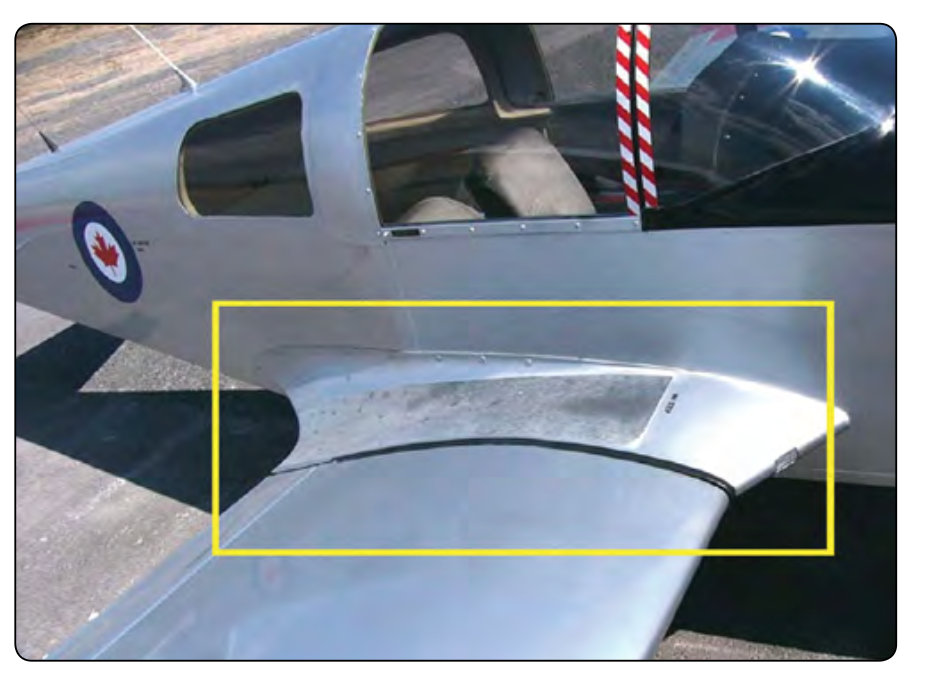
- Interference drag is when currents of air flowing over the airplane is interrupted where two parts of the aircraft meet.
- E.g., where the wing root meets the fuselage. Interference Drag
Skin friction drag: is caused by the roughness, under a microscopic scale, of the airplane’s surfaces.
Induced Drag
Induced Drag is a byproduct of lift.
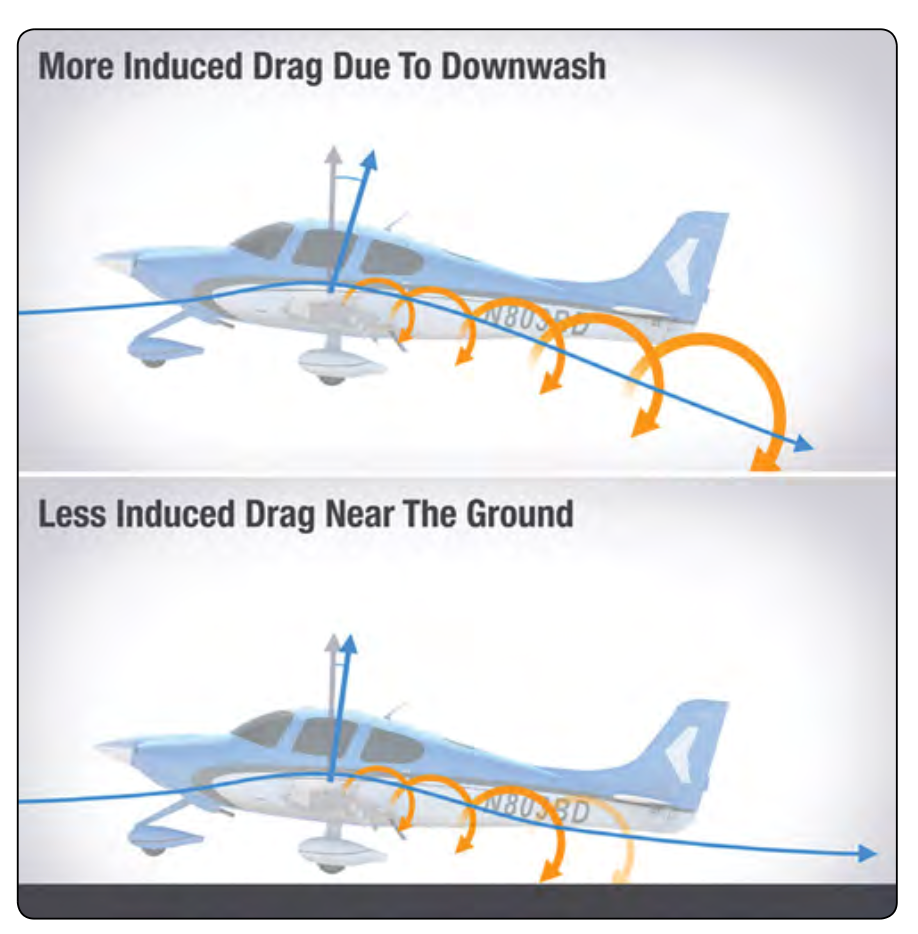
The high pressure air beneath the wing joins the low pressure air above the wing at the trailing edge and wingtips. This causes a spiral or vortex which trails behind each wingtip whenever lift is being produced. These wingtip vortices have the effect of deflecting the airstream downward in the vicinity of the wing, creating an increase in downwash. Therefore, the wing operates in an average relative wind which is inclined downward and rearward near the wing. Because the lift produced by the wing is perpendicular to the relative wind, the lift is inclined aft by the same amount. The component of lift acting in a rearward direction is induced drag.
The formation of induced drag
- High pressure air joins low pressure air at the trailing edge of the wing and wingtips.
- Wingtip vortices develOp.
- The downwash increases behind the wing.
- The average relative wind is inclined downward and rearward and lift is inclined aft. The rearward component of lift is induced drag.
Relationship Between Speed and Induced Drag
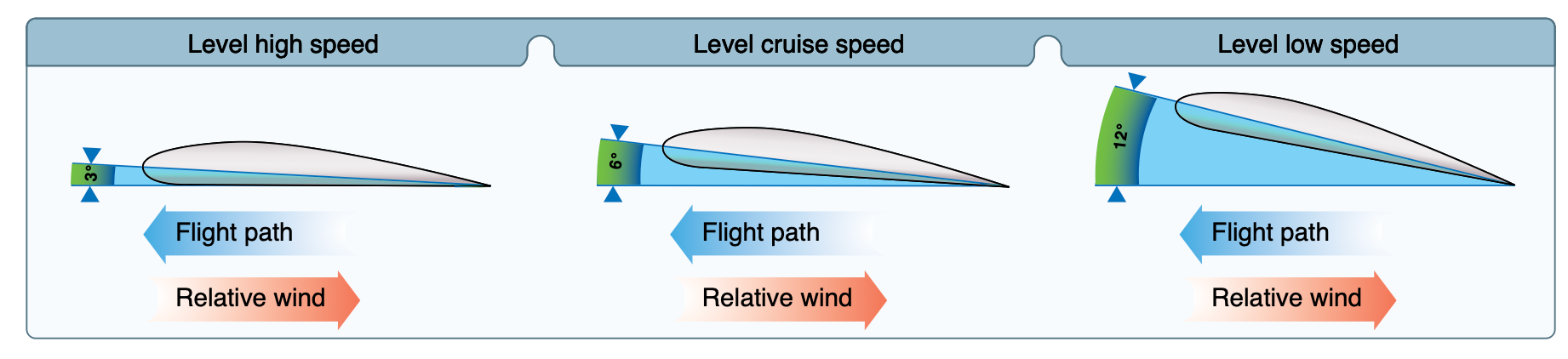
- Higher Speed → Lower AoA → Less Induced Drag
- Lower Speed → Higher AoA → More Induced Drag
The Total Drag Curve
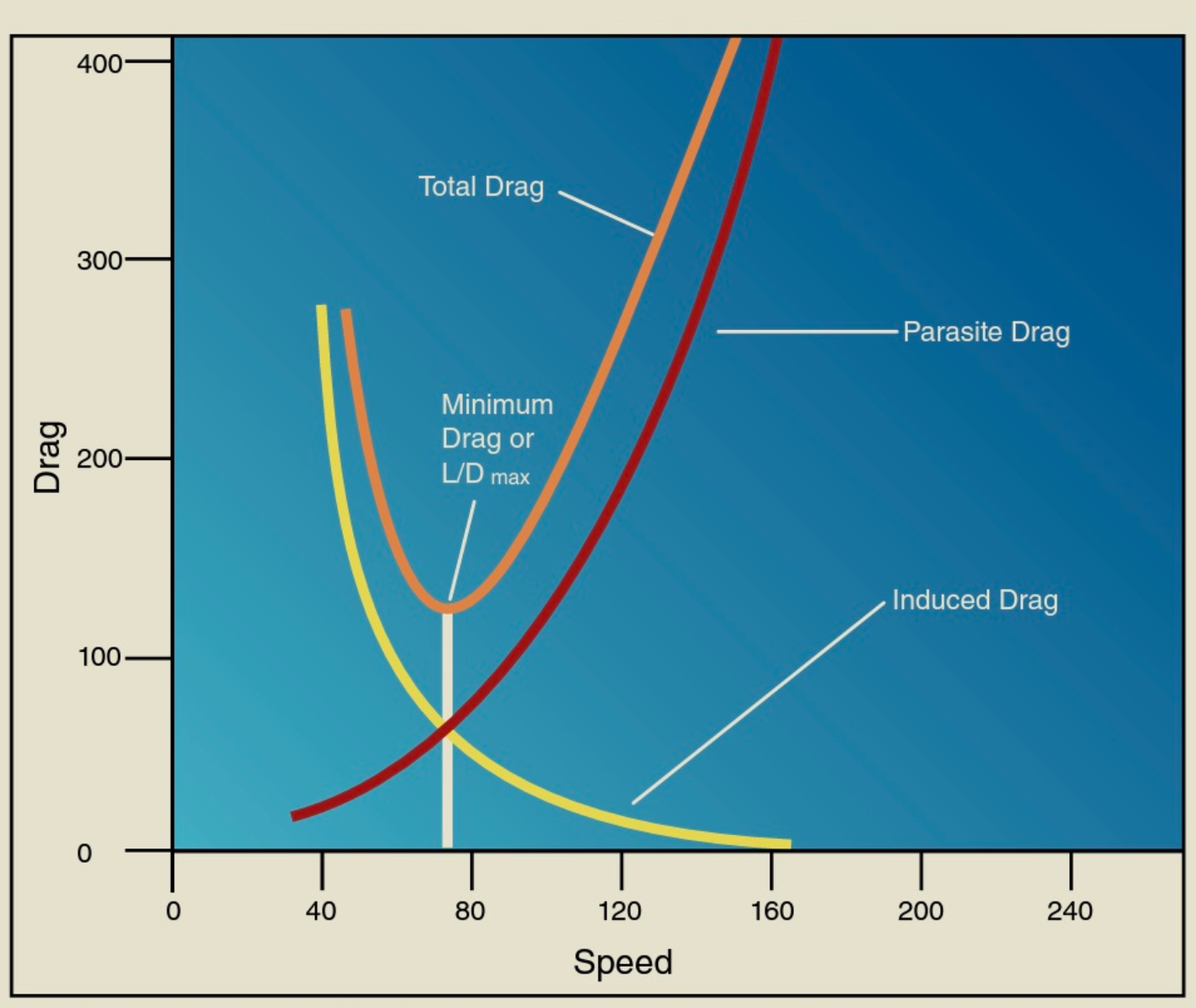
The aircraft can’t separate the two types of drag. The aircraft is actually responding to both parasite and induced drag combined into what we call the total drag curve.
- Total drag curve starts high, because at slow speeds induced drag is high.
- Total drag curve ends high, because at high speeds parasite drag is high.
- The low point on the total drag curve shows the airspeed at which drag is minimized. This point, where the lift-to-drag ratio is greatest, is referred to as L/Dmax.
Ground Effect
The phenomenon of groun ground effec effect is associated with the reduction of induced drag.
When we’re flying aircraft down close to the surface, the hard surface will dissipate that downwash and dissipate the airflow around those wingtips, and the relative wind flattens a little bit over the top of this airfoil, and the lifting force, which is perpendicular to the relative wind, shifts slightly forward.
Ground effect is noticeable in the landing phase of flight within one wingspan above the ground.