Stability
DEFINITION: Stability is the inherent quality of the aircraft to return or correct itself back to its original flight path. The two types of stability are static and dynamic.
Static Stability
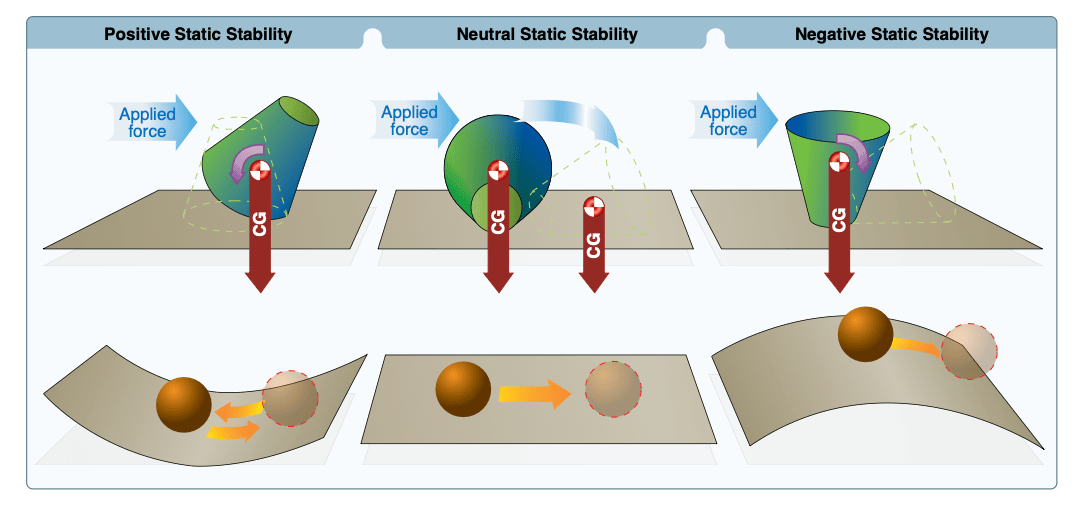
Static stability refers to the initial tendency, or direction of movement, back to equilibrium. In aviation, it refers to the aircraft’s initial response when disturbed from a given pitch, yaw, or bank.
Positive static stability:
the initial tendency of the aircraft to return to the original state of equilibrium after being disturbed.
Neutral static stability: the initial tendency of the aircraft to remain in a new condition after its equilibrium has been disturbed.
Negative static stability: the initial tendency of the aircraft to continue away from the original state of equilibrium after being disturbed.
Dynamic Stability
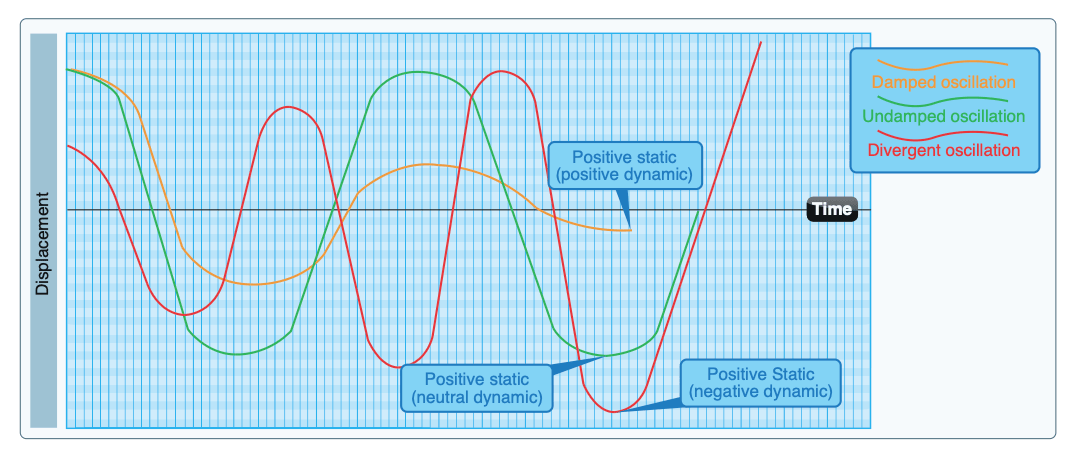
Static stability has been defined as the initial tendency to return to equilibrium that the aircraft displays after being disturbed from its trimmed condition. Occasionally, the initial tendency is different or opposite from the overall tendency, so a distinction must be made between the two.
Dynamic stability refers to the aircraft response over time when disturbed from a given pitch, yaw, or bank. This type of stability also has three subtypes:
Positive dynamic stability: over time, the motion of the displaced object decreases in amplitude and, because it is positive, the object displaced returns toward the equilibrium state.
Neutral dynamic stability: once displaced, the displaced object neither decreases nor increases in amplitude. A worn automobile shock absorber exhibits this tendency.
Negative dynamic stability: over time, the motion of the displaced object increases and becomes more divergent
Three Axes of Flight
Lateral Axis: The lateral axis of the airplane moves from wingtip to wingtip. Think of “lats"as in your back muscle. The movement around that lateral axis is a fore and aft movement or, from the pilot’s perspective, it’s like an up and down movement. Pilots call that a pitching movement, and that movement is created—is controlled—by the elevators.
Longitudinal Axis: Now the second one we’ll talk about is the longitudinal axis. When we say longitudinal, think “long.” The longitudinal axis goes from the nose through the tail. Now if you can imagine that axis, you can think of the airplane rolling left and right around that longitudinal axis. That longitudinal rolling motion is controlled by the ailerons. The ailerons control roll around the longitudinal axis.
Vertical Axis: The third axis is the vertical axis. Imagine this axis going vertically through the center of gravity of the aircraft. So the aircraft nose is moving left and right in a flat plane. That motion is called yawing , and that yawing motion is controlled with the rudder.
TL;DR
- Lateral axis: Wingtip to wingtip; the motion is called pitching; the flight control is the elevator.
- Longitudinal axis: Nose to tail; the motion is called rolling; the flight control is the aileron.
- Vertical axis: Vertical through the center of gravity; the motion is called yawing; the flight control is called the rudder.
Primary Flight Controls
Ailerons (ROLL)
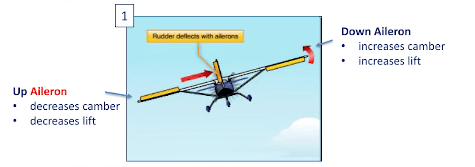
When we move the aileron to the left, we’re going to roll the airplane to the left by creating more lift on the right wing. If the aileron on the right wingtip goes down, that makes a larger angle of attack, that makes more lift, that makes a rolling motion to the left. Notice the left aileron is going up.
In summary of the diagram:
- ailerons to the left,
- → the right one goes down,
- → makes more lift,
- → that wing rises,
- → the airplane rolls to the left.
How about a right turn? Exactly the opposite’s happening. That’s the first primary flight control, the aileron. It controls roll around the longitudinal axis.
Elevator/Stabilator (PITCH)
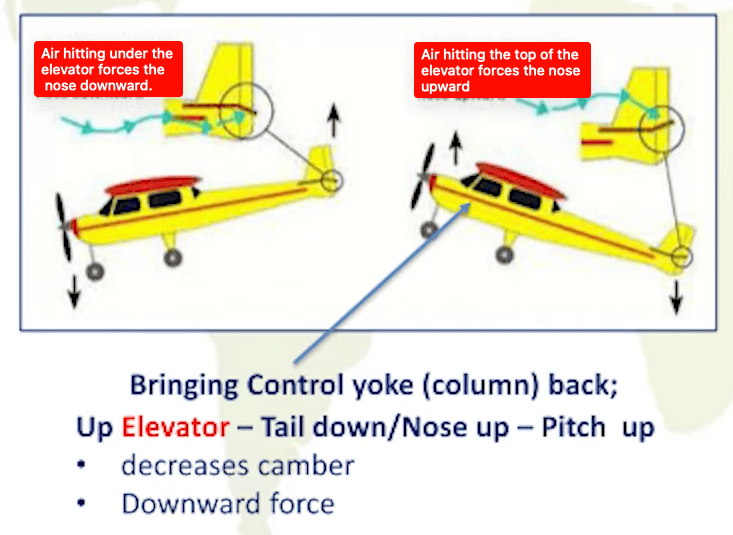
The elevator or the stabilator controls the pitching motion around the lateral axis. There are two primary designs of the flight controls that control pitching.
The Elevator:
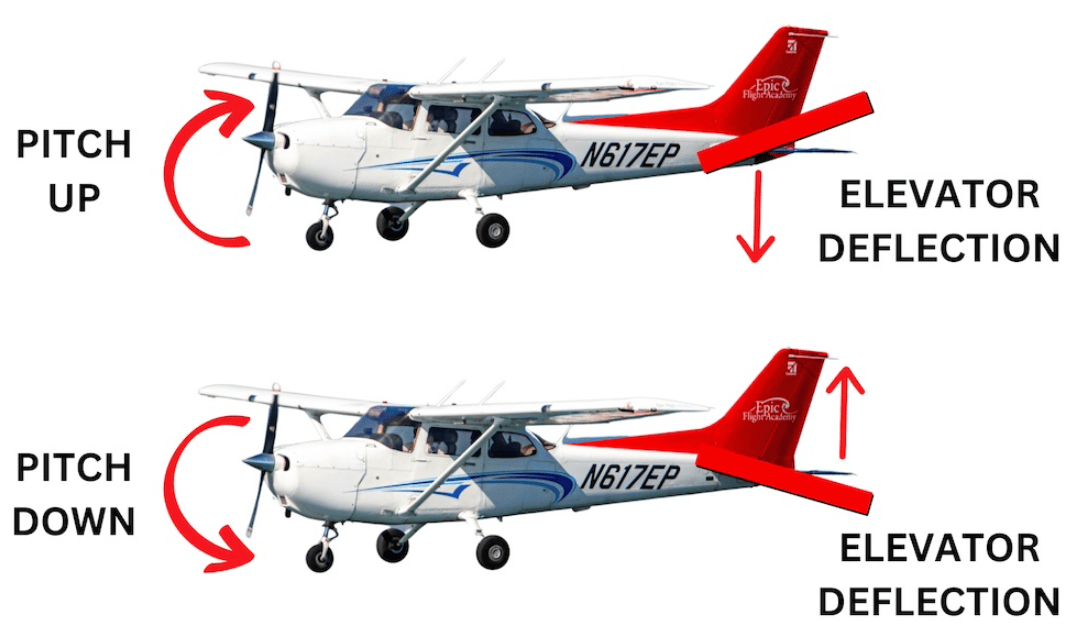
As this diagram shows, this aircraft has a horizontal stabilizer with an elevator attached to it.
The elevator moves up,
→ the tail moves down,
→ which means the nose of the airplane moved up.
If the elevator moves down,
→ the tail moves up,
→ which means the nose of the airplane moved down.
The Stabilator:
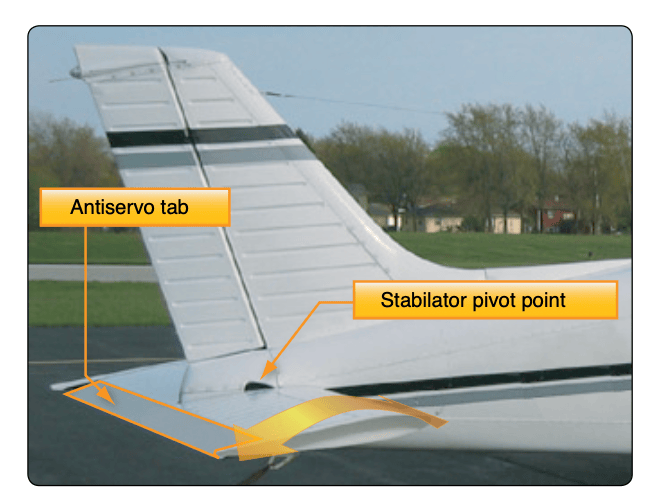
The second design for pitch control is called the stabilator. On the stabilator, the entire stabilator moves, unlike on the elevator where the horizontal stabilizer was stationary and the elevator moved. Here the entire stabilator is moving and is being pitched by the anti-servo tab.
Rudder (YAW)
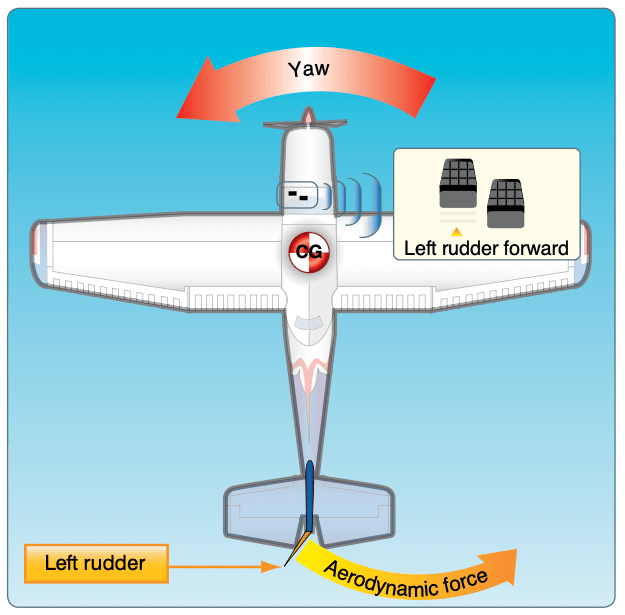
The rudder yaws the airplane around the vertical axis. In the diagram, we’re looking at the aircraft from the top and you see the picture of the rudder pedals. where the pilot is putting his left foot forward on that left rudder pedal; you are actually moving the physical rudder to the left.
Now when that happens, the relative wind hits the tail and that rudder pushing the tail of the airplane to the right, and from the pilot’s perspective, the nose of the airplane yaws to the left.
Secondary Flight Controls
We have four types of secondary flight controls: those are flaps, leading edge devices, trim systems, and spoilers.
Flaps
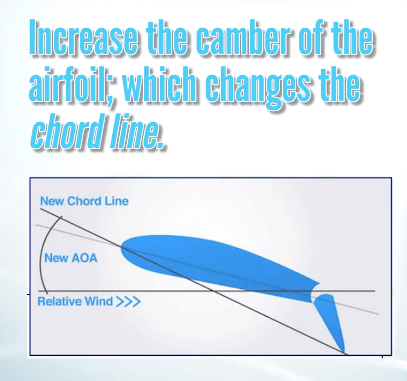
Flaps increase the camber of the airfoil by changing the chord line. The chord line was an imaginary line from the leading edge to the trailing edge. Take a look at this diagram and see how we’ve actually taken the trailing edge of this airfoil and dropped it down—in reality, that’s a flap.
So aerodynamically, we’ve changed the chord line. Remember the angle of attack was the angle between the chord line and the relative wind. So for the same relative wind, with the new chord line, we now have a larger angle of attack. This means that flaps help the airplane produce more lift at a slower speed.
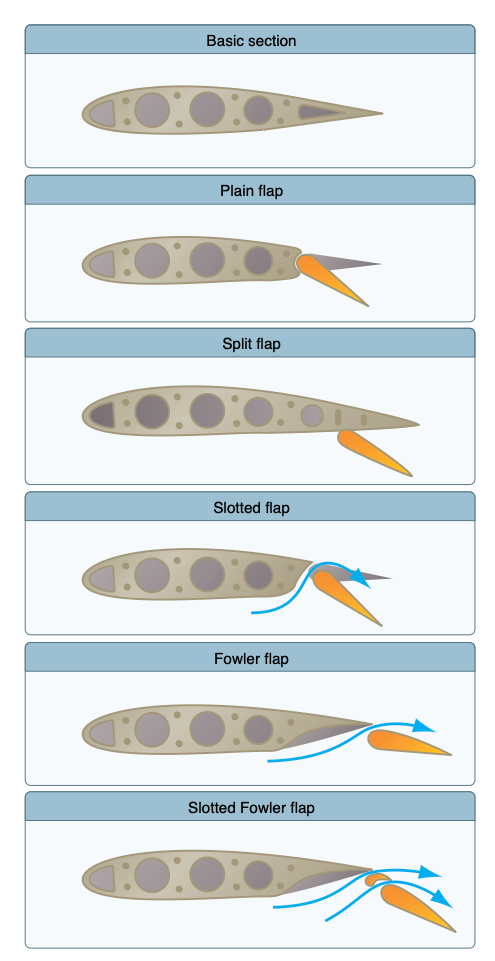
When we talk about flaps, we see that there are some primary types of flaps:
- The plain flap: That’s just like taking the back end of that airfoil and just dropping it down.
- The split flap: Notice the top of that airfoil camber stayed in place and the bottom dropped down.
- The slotted flap: Similar to that plain flap except in this case you see that open air slot between the wing and the flap.
- The Fowler flap: The Fowler flap not only goes down, it’s also moving aft at the same time.
- The slotted fowler flap: Similar to the Fowler flap except there’re more open air slot between the wing and the flap.
Trim Systems
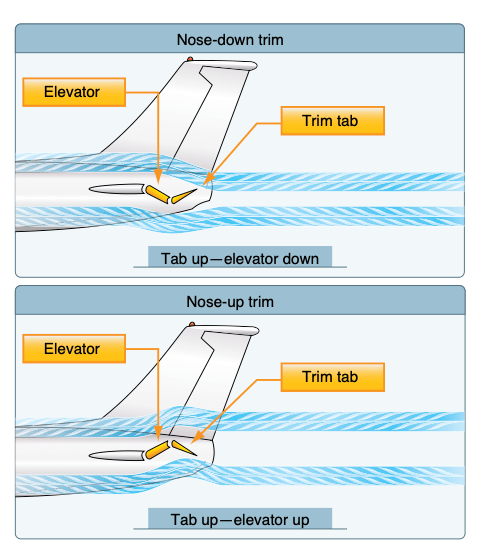
The trim tab is used on aircraft that have horizontal stabilizers with elevators. So you can see in this diagram: horizontal stabilizer, an elevator, and on the trailing edge of that elevator is a trim tab.
Trim tabs helps relieve pilot control pressure.
Let’s say we’re holding the aircraft in a steady climb. See how the elevator is up, which pushes the tail down, which pushes the nose up, and we want to hold the aircraft in that position for a while and climb up to altitude. We can put the trim tab in the down position to help hold the elevator up. That takes pressure off of the pilot’s yoke.
Other types of trim tab that you might come across are Balance Tabs, Servo Tabs, or Antiservo Tabs; all of which are used on relief the pilot’s control pressure. You may find more details at PHAK P. 6-11.
Leading Edge Devices
The leading edge device that we want to talk about is called the slat. Unlike flaps, slats are on the leading edge of the wing. And like flaps that drop down, slats also drop down, but they drop down on the leading edge.
Now the reason for this is so high-speed aircraft, when they move to slower speeds, can drop both the slats and the flaps and at these slower speeds control the airflow over the new camber on this wing to prevent it from reaching a critical angle of attack and allowing it to fly at a slower speed.
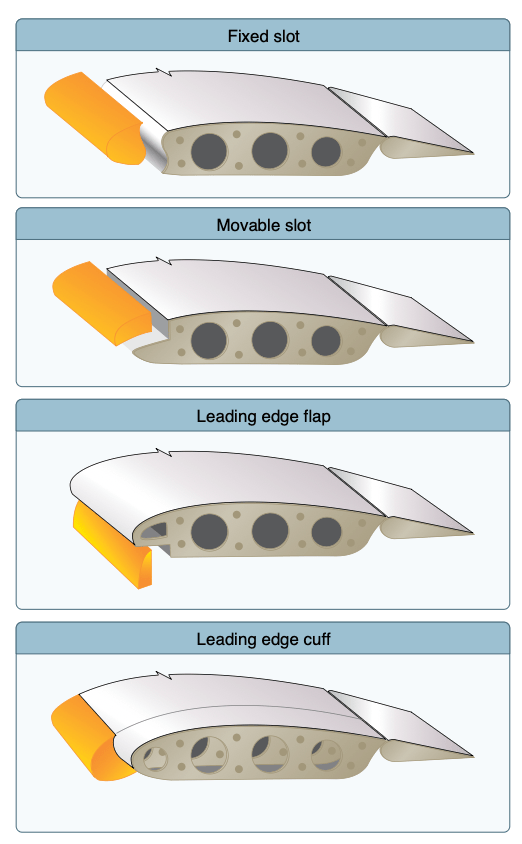
High-lift devices also can be applied to the leading edge of the airfoil. The most common types are fixed slots, movable slats, leading edge flaps, and cuffs.
Leading edge flaps, like trailing edge flaps, are used to increase both CL-MAX and the camber of the wings. This type of leading edge device is frequently used in conjunction with trailing edge flaps and can reduce the nose-down pitching movement produced by the latter. As is true with trailing edge flaps, a small increment of leading edge flaps increases lift to a much greater extent than drag. As flaps are extended, drag increases at a greater rate than lift.
Spoilers
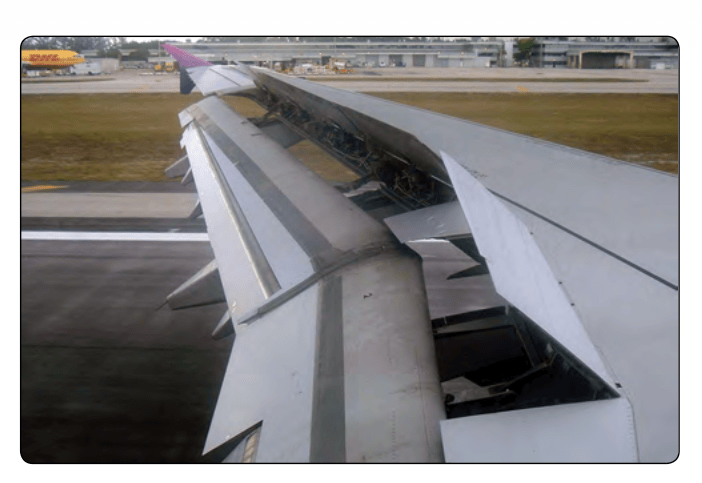
Spoilers devices can be found on high-speed aircraft, typically jet aircraft. In the following diagram you can see the spoilers raised on the left wing. The spoilers do exactly what they say: they spoil the lift created by that wing. These secondary flight controls are used on the ground to help the aircraft slow down.