Fuel Injection System
Fuel Injection Generics
The Wing Tanks
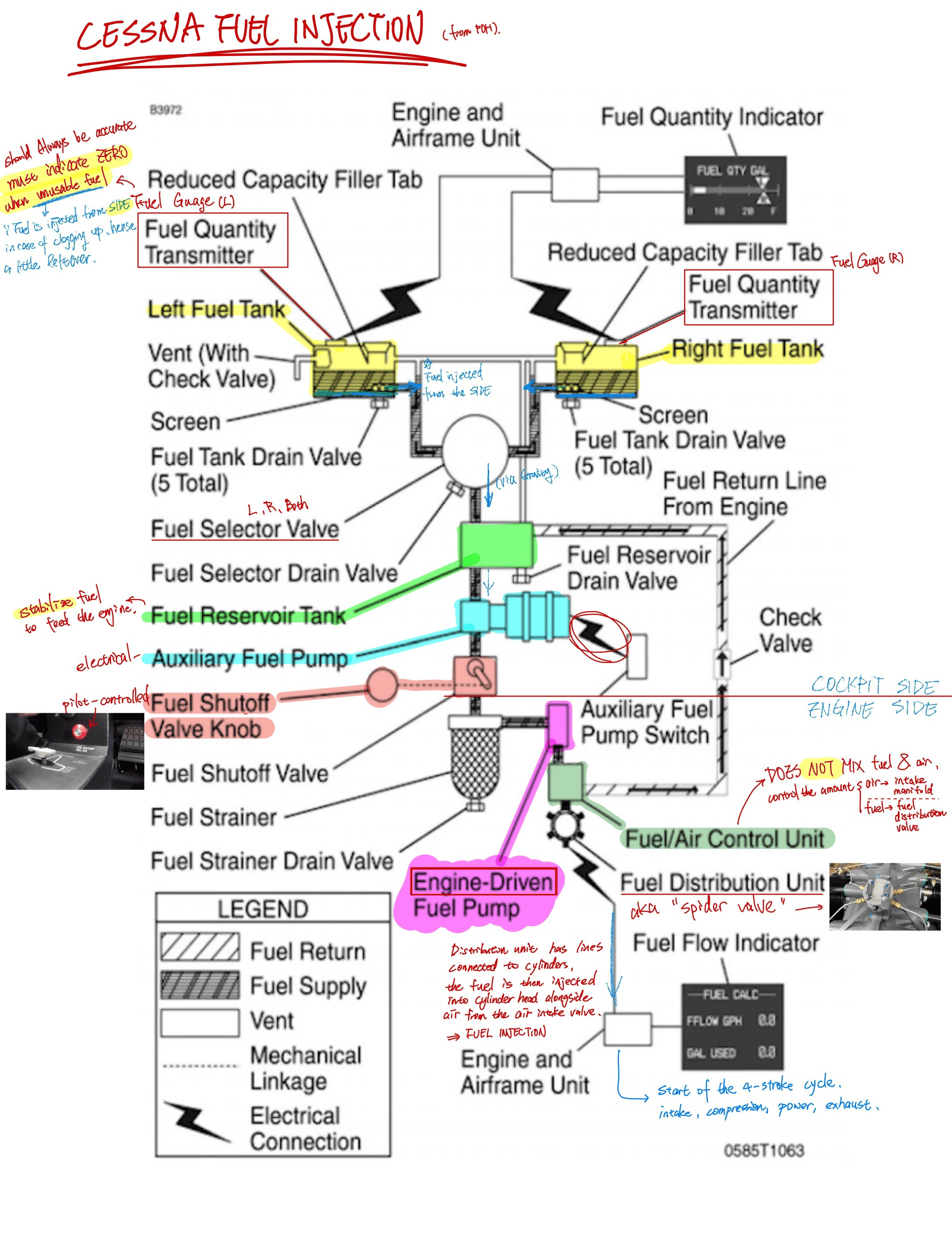
This is the schematic that you’re going to find in your POH. We start up here at the top in the wing tanks. Now already right out of the gate, I want you to notice two things.
The Fuel Gauges: The first thing to notice is that these tanks each have a fuel gauge and this fuel gauge must indicate accurately. If you’ve ever heard that fuel gauges only need to be accurate when the tank is empty, that’s a misconception. These fuel tanks have to indicate accurately and the gauges must show zero when the tanks have unusable fuel.
Unusable Fuel: Why would I have fuel in my tanks that I can’t use? Well, that’s the second thing I want you to notice. Take a look at this wing tank here and see where the fuel is drawn from the tank. Notice it’s not drawn from the bottom of the tank; it’s drawn near the bottom of the tank but from the side. The reason for that is an extra precaution to prevent any contaminants from clogging up the fuel pickup off of the tank. If we draw the fuel down to the level where it’s being picked up out of the tank there, there’ll be a little bit of fuel left over and that’s unusable fuel.
Fuel Selection and Reservoir
From the tank, the fuel flows by gravity down these lines to the fuel selector. At the fuel selector, we see a drain valve that’s accessed from the bottom of the airplane when we’re taking fuel samples. Now the fuel selector on the 172 will allow you to select left, right, or both tanks.
From that fuel selector, the fuel moves forward to what we call a reservoir tank. Now this reservoir holds a couple of gallons and it serves the purpose of—think about it as stabilizing the fuel flow from the tanks into the engine. It takes fuel from both of the wing tanks and kind of has a nice little stabilized quantity here to feed the engine.
Pumps and Shut-off Valve
The next item in the schematic you’re going to see is an auxiliary fuel pump. It’s auxiliary meaning it’s additional, it’s secondary, it’s a backup. This fuel pump is driven electrically and you see that right here—it’s called the auxiliary fuel pump and the little lightning bolt means that it’s driven electrically. You’ve got a switch on your panel to turn it on and off.
Now at that point, the fuel will flow from the cabin side of the aircraft through the firewall to the engine side of the aircraft. At that firewall is a shut-off valve. That shut-off valve is controlled by you, the pilot. There’s a red knob in the cockpit and if you pull that, you can shut this fuel off. Your flight instructor will work with you on that; that is there in the event of an emergency.
The Engine Side
Now we are forward of the firewall. When a pilot says forward the firewall, we mean we are on the engine side of the firewall. As we continue our journey, what’s the first thing we find? The fuel strainer.
From the fuel strainer, fuel is routed to—hey look at that, it’s another fuel pump—but notice this one is engine-driven. This fuel pump is mounted on the engine and when the engine turns, this fuel pump turns and is moving fuel.
The Fuel Air Control Unit and Distribution
This engine-driven fuel pump moves that fuel to the fuel air control unit. Now if you have studied carburetors, this is where the big difference occurs. This fuel air control unit does not mix the fuel and air. It controls the amount of air that flows to the intake manifold and it controls the amount of fuel that flows to the fuel distribution valve. It does not mix them.
Once that fuel air control unit determines how much air and how much fuel is needed, that fuel quantity is sent to the fuel distribution valve. Now if you take a look at it here, it might look like some kind of a little insect, maybe legs sticking out of it. You might hear pilots refer to this as the “spider valve.” Have no fear, there’s no spiders in your engine.
This spider valve has a line to each of the four cylinders and the fuel is injected directly into the cylinder head alongside the air that’s coming from the air intake valve—hence the term fuel injection.
Finally, Fuel injection
Now that fuel injection, once it is in the cylinder, then we start that four-stroke cycle: intake, compression, power, and exhaust.
Key Takeaway
- Fuel Tanks (Left & Right): Gravity-fed wing tanks; pickups are slightly raised to avoid drawing in settled contaminants.
- Fuel Selector Valve: Allows the pilot to draw fuel from the Left tank, Right tank, or Both.
- Reservoir Tank: A small tank that stabilizes fuel flow and ensures a steady supply during maneuvers.
- Auxiliary Fuel Pump: An electric backup pump used for engine priming and emergency situations.
- Fuel Shutoff Valve: A safety control that allows the pilot to completely stop fuel flow to the engine.
- Fuel Strainer: Filters out fine sediment and water before the fuel enters the engine components.
- Engine-Driven Fuel Pump: The primary mechanical pump that provides high-pressure fuel whenever the engine is turning.
- Fuel / Air Control Unit: Meters the precise amount of fuel needed based on throttle position (does NOT mix air/fuel here).
- Fuel Distribution Unit: Also called the “Spider Valve”; it evenly divides the metered fuel to each cylinder.
- Fuel Injector Nozzles: Sprays the fuel directly into the intake port of each cylinder head for combustion.