Note
The turbojet is the name used for a gas turbine engine designed to produce thrust by discharging exhaust gases at high speed out of the rear of the engine, i.e., the “jet,” which is done through a suitably shaped propelling nozzle. An aircraft turbine engine consists of an air inlet, compressor, combustion chambers, a turbine section, and exhaust.
Types of Turbine Engines
Turbojet Engine
The turbojet engine consists of four sections—compressor, combustion chamber, turbine section, and exhaust.
The compressor section passes inlet air at a high rate of speed to the combustion chamber. The combustion chamber contains the fuel inlet and igniter for combustion. The expanding air drives a turbine, which is connected by a shaft to the compressor, sustaining engine operation. The accelerated exhaust gases from the engine provide thrust. This is a basic application of compressing air, igniting the fuel-air mixture, producing power to self-sustain the engine operation, and exhaust for propulsion.
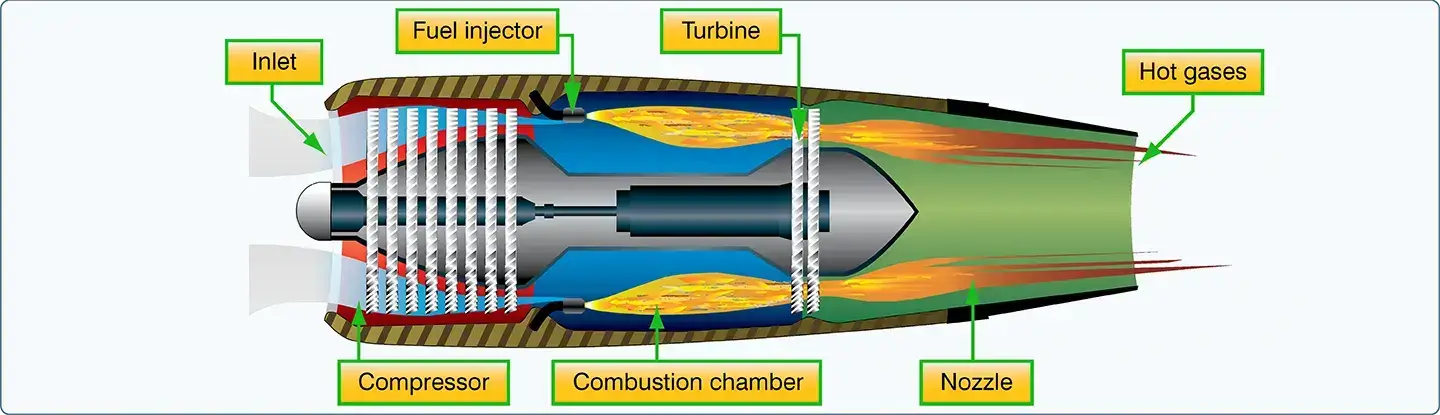
Schematic
Inlet air → Drives the Turbine → Drives the Compressor/Gear box → Then turn the propeller → Combustion Chamber contains fuel for combustion (Ignition) → Expanding air drives a turbine (Power Extraction) → → Turbine connected by shaft to the compressor → Exhaust from the engine (Thrust)
Inlet Air ──▶ [ Compressor ] ──▶ [ Combustion ] ──▶ [ Turbine ] ──▶ Exhaust
                        ▲                                  │
                        └─────────── ( Shaft ) ────────────┘
Advantages of turbojet engine
Relatively simple design
Capable of very high speeds
Takes up little space
Disadvantages of turbojet engine
High fuel consumption
Loud
Poor performance at slow speeds
Limited in range and endurance
Turboprop
A turboprop engine is a turbine engine that drives a propeller through a reduction gear, which is a combination of a gas turbine engine, reduction gearbox, and propeller.
However, the difference is that the turbine in the turboprop engine usually has extra stages to extract energy to drive the propeller. In addition to operating the compressor and accessories, the turboprop turbine transmits increased power forward through a shaft and a gear train to drive the propeller. (Approximately 85–90 percent of the engine’s energy is converted into shaft power to drive the propeller)
Schematic
Inlet air
→ Drives the Turbine
→ Drives the Compressor/Gear box
→ Drives the Propeller
Inlet Air ──▶ [ Compressor ] ──▶ [ Combustion ] ──▶ [ Turbine ] ──▶ Exhaust
                         ▲                                  │
                         │          (Main Shaft)            │
                         └──────────────────────────────────┤
                                                            ▼
    [ Propeller ] ◀────── [ Reduction Gearbox ] ◀───────────┘
     (85-90% Power)        (Speed Conversion)
Advantages of turboprop engine
Very fuel efficient
Most efficient between 200-350 knots
Most efficient at mid-range altitudes of 18,000-30,000 feet
Disadvantages of turboprop engine
Limited forward airspeed
Gearing systems are heavy and can break down
Turbofan Engine
Turbofans were developed to combine some of the best features of the turbojet and the turboprop. Turbofan engines are designed to create additional thrust by diverting a secondary airflow around the combustion chamber.
Almost all airliner-type aircraft use a turbofan engine. In high-bypass turbofan engines, as much as 80–90 percent of total thrust is produced by the bypass airflow. This engine is quieter and has better fuel efficiency in this speed range.
Advantages of turbofan engine
Fuel efficient
Quieter than turbojets
High thrust capability
Improved fuel economy at subsonic speeds
Disadvantages of turbofan engine
Heavier than turbojets
Larger frontal area than turbojets
Less efficient at supersonic speeds compared to turbojets
Turboshaft Engine
The fourth common type of jet engine is the turboshaft. It delivers power to a shaft that drives something other than a propeller. The biggest difference between a turbojet and turboshaft engine is that on a turboshaft engine, most of the energy produced by the expanding gases is used to drive a turbine rather than produce thrust. Many helicopters use a turboshaft gas turbine engine.
Advantages of turboshaft engine
Much higher power-to-weight ratio than piston engines
Typically smaller than piston engines
Disadvantages of turboshaft engine
Rotor and gearbox noise typically dominate overall helicopter sound levels.
Gear systems connected to the shaft can be complex and break down
Keynotes
| ENGINE TYPE | THRUST/POWER SOURCE | PEAK EFFICIENCY RANGE | KEY MODERN FEATURE |
|---|---|---|---|
| Turbojet | 100% Core Exhaust | Mach 1.5+ | High thrust-to-weight ratio; simple core. |
| Turbofan (High-Bypass) | 80–90% Bypass Air | Mach 0.75 – 0.85 | FADEC Control; Composite Fan Blades; 10:1+ Bypass Ratio. |
| Turboprop | 85–90% Propeller Shaft | 200 – 350 Knots | Free-turbine design; Fuel efficient at mid-altitudes. |
| Turboshaft | 100% Shaft Torque | Hover – 200 Knots | Independent power turbine for helicopter transmissions & APUs. |