Introduction to Airspace
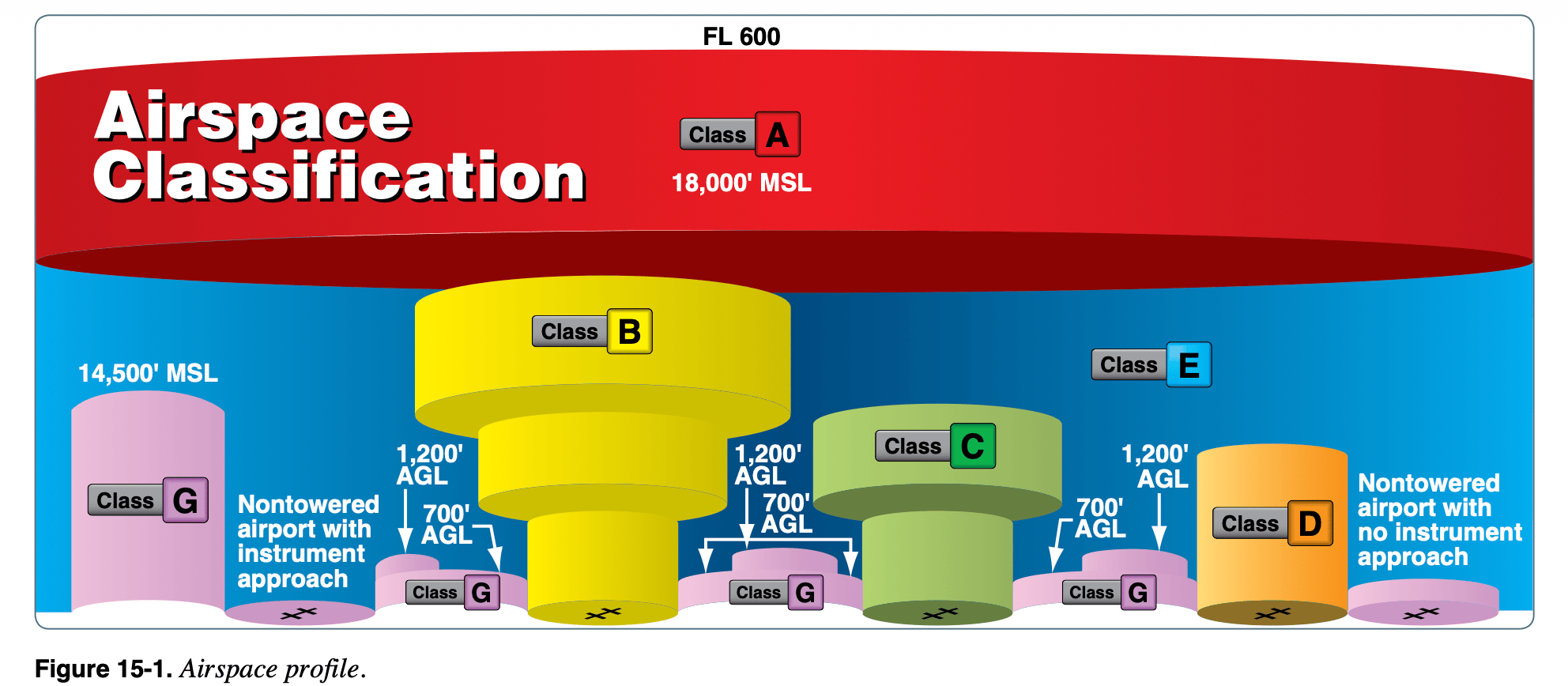
The AIM divides airspace into three main types:
- Controlled (A~E)
- Uncontrolled (G)
- Special Use
We will be talking about the Controlled and Uncontrolled Airspaces in this chapter. For Special Use Airspaces, read more at Special Use Airspaces
Controlled Airspaces
Class A (Alpha) Airspace
- Vertical Dimensions: Starts at 18,000 feet MSL (Mean Sea Level) up to and including Flight Level 600.
- Requirements:
- The pilot and aircraft must be on an IFR flight plan.
- The pilot must be instrument rated.
- The aircraft must have a Mode C transponder (altitude encoding) and ADS-B Out.
- Altimeter Setting: At 18,000 feet, all altimeters are set to 29.92" Hg so all aircraft have the same pressure reference.
Class B (Bravo) Airspace
Class B as in “Big Planes/Airports
Class B Airspace is for the country’s largest and busiest airports, like Orlando, Miami, Tampa, Atlanta, or Chicago.
- Shape: Think of a big upside-down wedding cake. The inner ring starts at the surface, and the outer rings move up in altitude (shelves). These are individually tailored for each airport.
- Vertical Dimensions: Generally extends from the surface up to 10,000 feet MSL.
- The Mode C Veil: There is an outer “veil” with a 30 nautical mile (NM) radius. If you fly inside this veil, you must have a Mode C transponder.
- Requirements to Enter:
- Specific Clearance: You must be specifically cleared to enter. Simply talking to ATC is not enough; you must hear the words “Cleared into Class Bravo airspace.”
- Equipment: Two-way radio, Mode C transponder, and ADS-B Out.
- Pilot Certificate: Minimum of a Private Pilot Certificate (though students can enter with specific instructor endorsements).
- Speed Limits: - Below 10,000 feet, speed is limited to 250 knots.
- If flying underneath a Bravo “shelf,” the limit is 200 knots.
- Weather Minimums: - 3 statute miles (3 sm) visibility
- clear of clouds.
Class C (Charlie) Airspace
Class B as for “Communication”
To enter Charlie Airspace, Like Bravo, you must communicate with ATC, but you don’t need a specific “clearance” to enter. You are considered cleared once ATC responds to you using your aircraft call sign.
- Shape: Generally a two-tiered airspaces
- Dimensions:
- Inner Circle (Core): 5 NM radius, from surface to 4,000 feet AGL.
- Outer Circle (Shelf): 10 NM radius, from 1,200 feet to 4,000 feet AGL. Requirements and Weather:
- Equipment: Two-way radio, Mode C transponder, and ADS-B Out.
- Speed Limit: 200 knots within 4 NM of the airport at or below 2,500 feet.
- Weather Minimums (C-152):
- 3 statute miles visibility.
- 1,000 feet above clouds.
- 500 feet below clouds.
- 2,000 feet horizontal from clouds.
Class D (Delta) Airspace
Delta airspace exists at smaller airports that are tower-controlled. Sometimes these towers have limited hours. When the tower shuts down, the Delta airspace reverts to either Echo or Golf (check the Chart Supplement).
As a general rule, you should avoid Class D airspace except to take off or land at an airport within the area.
- Dimensions: A 4 nautical mile radius from the surface up to 2,500 feet AGL.
However, The FAA may “tweak” the shape. For example, at New Smyrna, we are under the shelf of overlying Charlie airspace, so our Delta ends where the Charlie begins. - Depiction: It is depicted on your sectional chart by a blue dashed line.
- Requirements: - You do not need a Private Pilot’s license; students can fly here.
- You must have two-way radio communication.
- Speed Limit: 200 knots within 4 nautical miles of the airport below 2,500 feet.
- Weather Minimums (C-152): - 3 statute miles visibility.
- 1,000 feet above clouds.
- 500 feet below clouds.
- 2,000 feet horizontal from clouds.
Class E (Echo) Airspace
Class E for “Everything else”
If it’s not A, B, C, or D, and it’s controlled, it’s Echo. It is technically controlled airspace, but you don’t need a flight plan or a specific clearance to fly VFR. Think of it as “controllable"—ATC can control traffic there, but you aren’t always under their control.
Types of Class E Airspaces: STOVE
- Surface Area:
If you see a magenta dashed line, it is Class E airspace that serve as extensions to Class B, Class C, and Class D surface areas designated for an airport. This airspace protects standard instrument approach procedures without imposing communication requirement on pilots operating VFR.
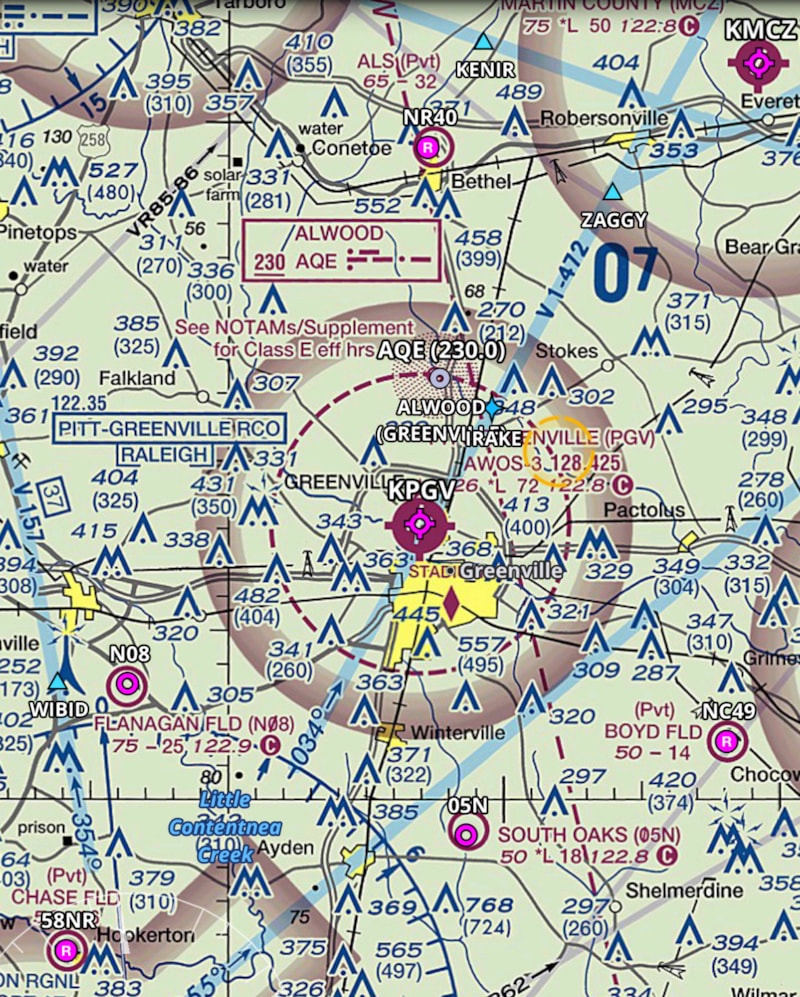
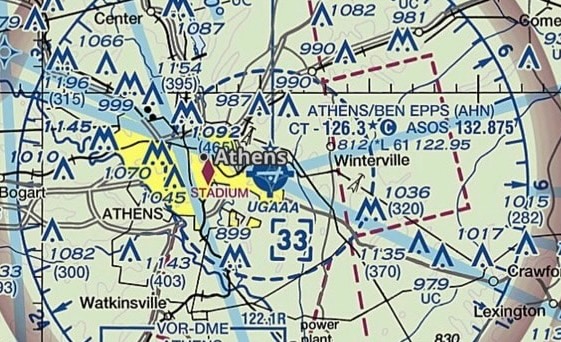
Transition Airspace:
Permits IFR traffic in the en route and airport environment to remain in controlled airspace while transitioning.- Begins at 700’ AGL (magenta vignette) - Begins at 1,200’ AGL (Blue vignette)
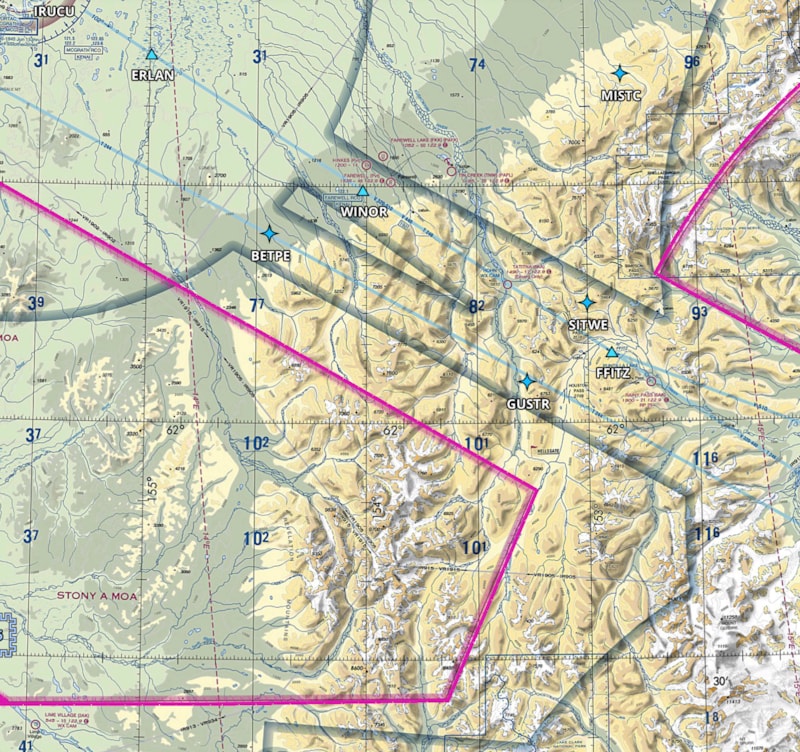
Transition Airspace
- Begins at 700’ AGL (magenta vignette) - Begins at 1,200’ AGL (Blue vignette)
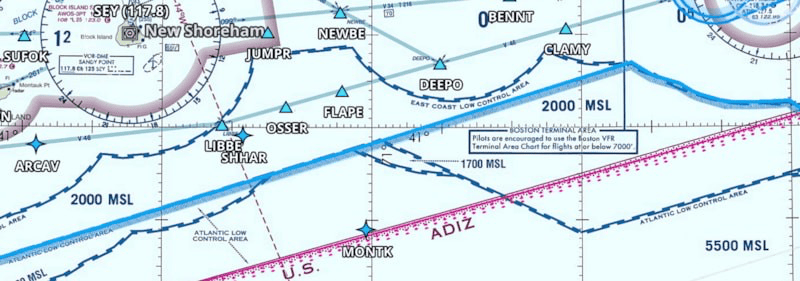
Offshore Airspace:
- Airspace areas extending upward from a specified altitude to, but not including, 18,000’
- Airspace beyond 12 miles from the coast of the US
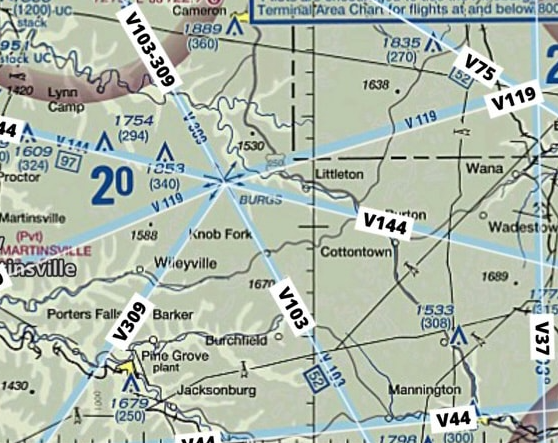
- VOR (Victor Airways): Connects one NAVAID to another
- Airways are usually 8 nm wide (4 nm on each side of the centerline)
- Extend upward from 1,200’ AGL up to, but not including, 18,000’ MSL
- Everywhere Else and Above:
- If it’s not in any of the others airspaces, everywhere else is Class E up to, but not including, 18,000’ MSL
- Above 60,000’ MSL is technically classified as Echo airspace.
Uncontrolled Airspaces
Class G (Golf) Airspace
Class Golf is referred to as uncontrolled airspace. There is no requirement to talk to ATC or file a flight plan. It is pilot’s responsibility to “See and Avoid”.
- Dimensions: (Technically from the surface up to 14,500 feet MSL, unless it hits overlying Echo airspace.)
- Surface to below 14,500’ MSL
- Surface to below 700’ AGL (up to Class E)
- or Surface to below 1,200’ AGL (up to Class E)
- Equipment: If above 10,000 feet MSL, you must have a Mode C transponder and ADS-B Out.
- Speed Limit: Below 10,000 feet, you are limited to 250 knots.
Memory Aids
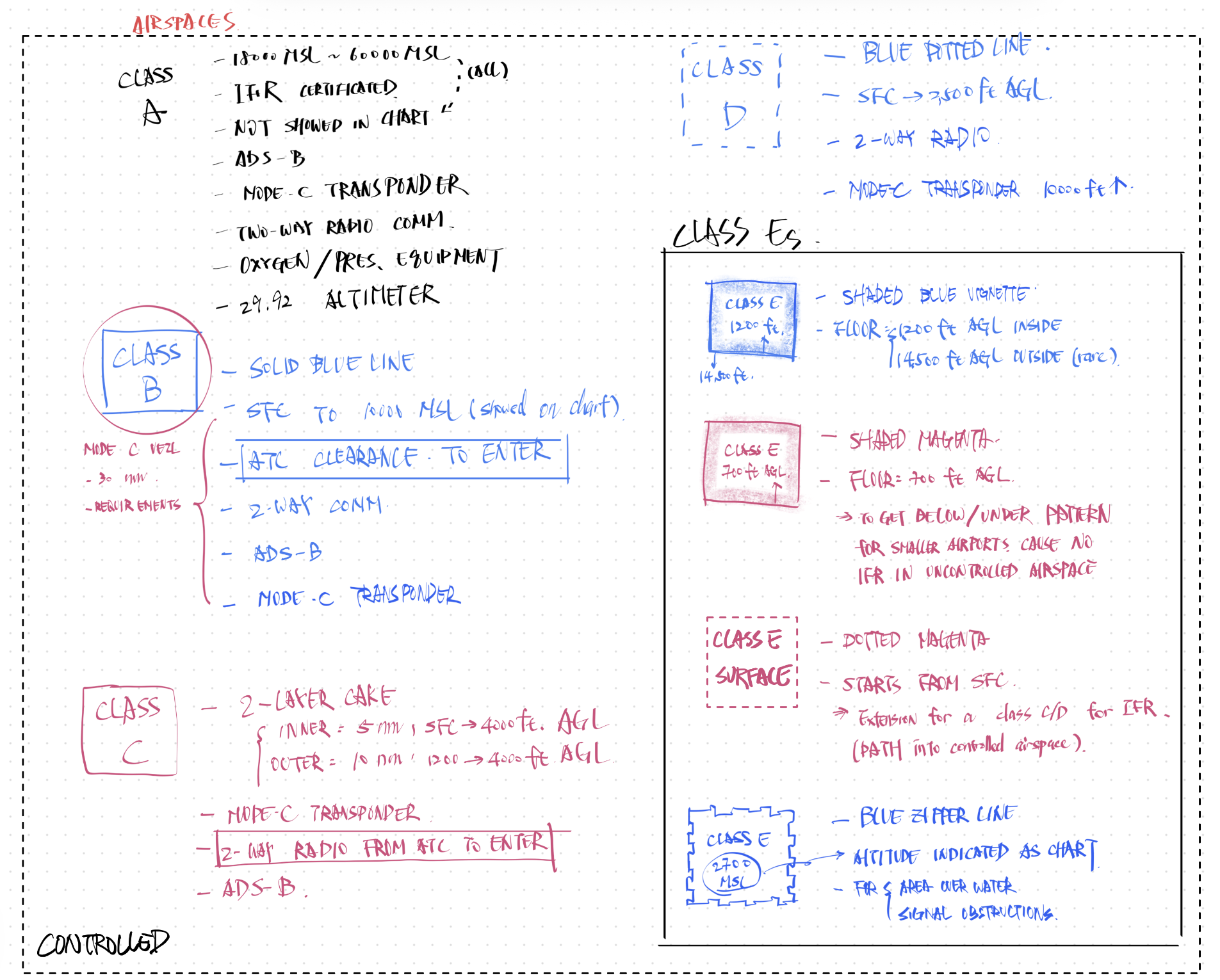
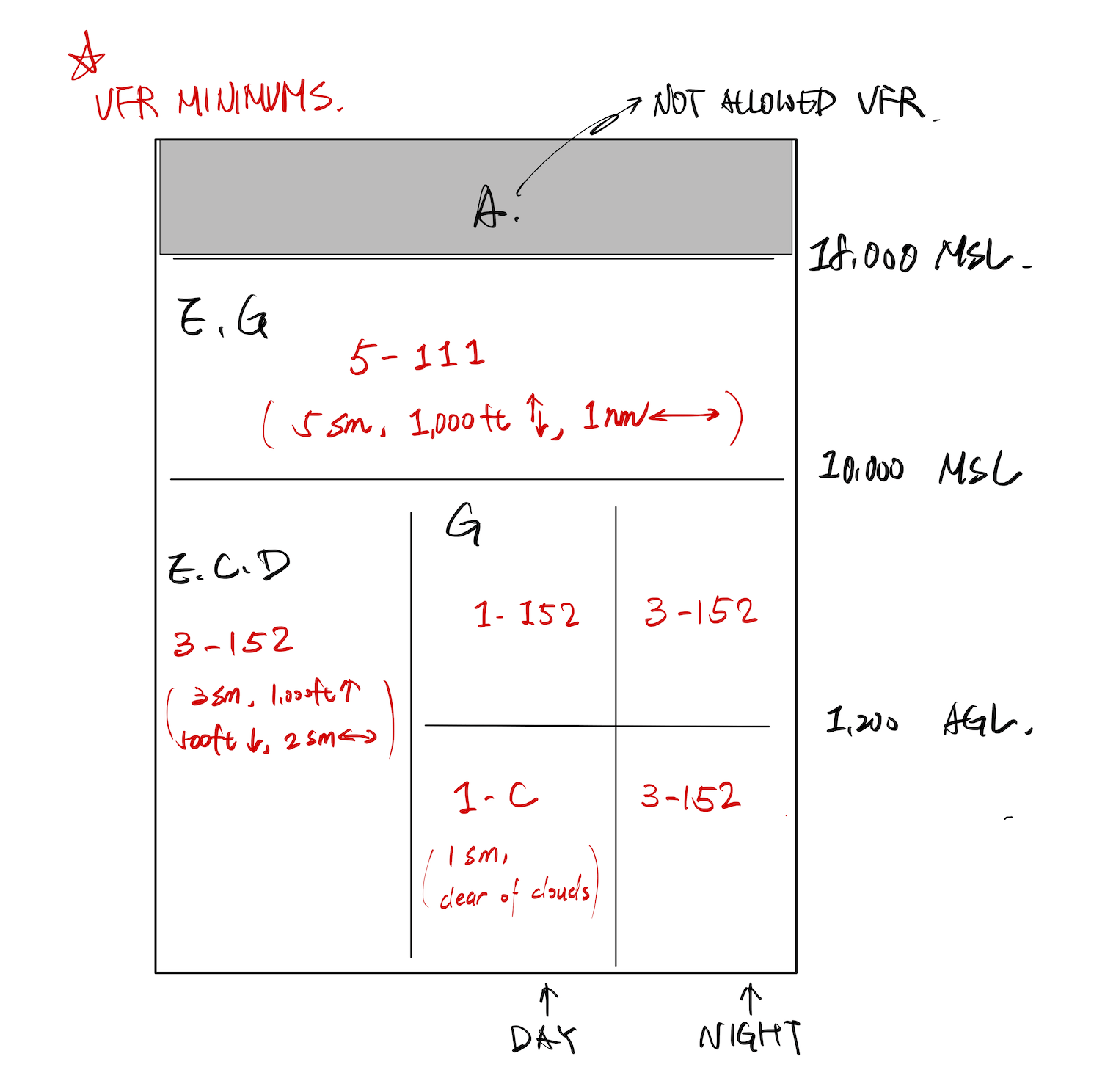
The following images are demonstrations of how I memorize airspaces’ requirements
Remarks
- RADAR (Radio Detection and Ranging) is a system that uses radio waves to determine the distance (ranging), direction (azimuth and elevation angles), and radial velocity of objects relative to the site.
- A Transponder is an electronic device aboard the airplane which enhances your aircraft’s identity on an ATC radar screen.