Special Use Airspaces
We will be talking about the Special Use Airspace in this chapter. For the (un)controlled airspaces, please referred to Controlled and Uncontrolled Airspaces
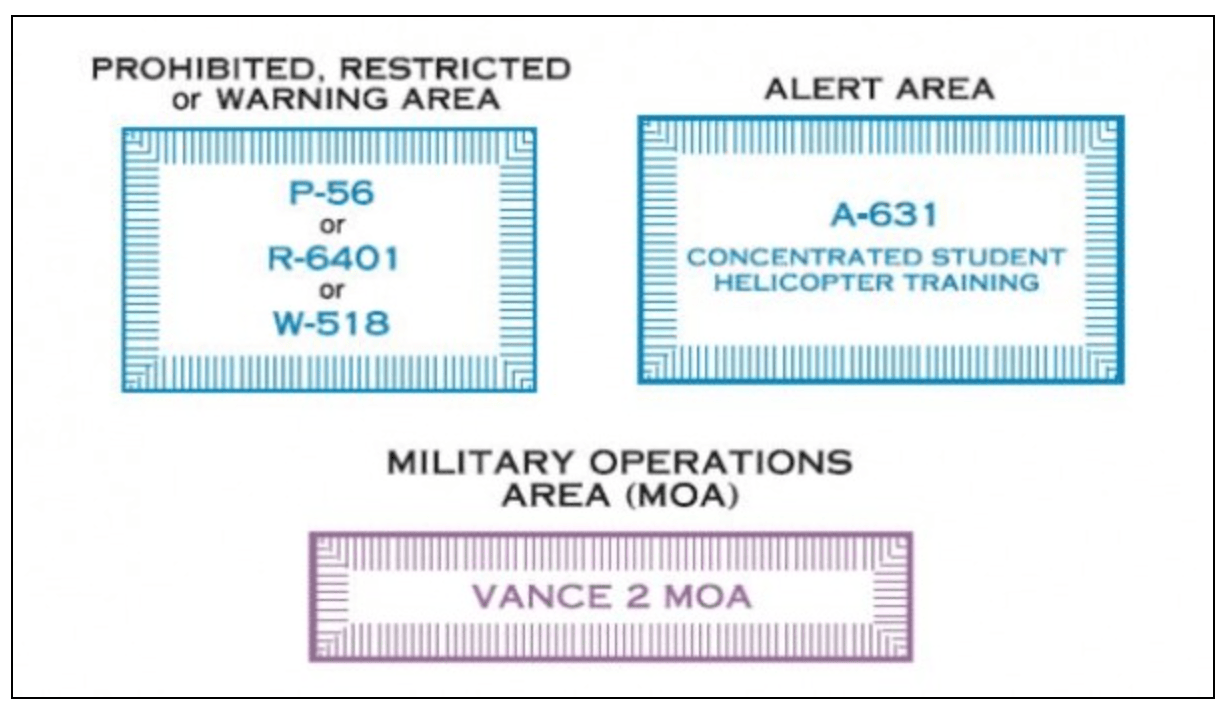
Special use airspace is used to confine certain flight activities and to place limitations on aircraft operations that are not part of these activities. Special use airspace is divided into alert areas, military operations areas(MOAs), warning areas, restricted areas, prohibited areas, controlled firing areas, special flight rules area(SFRAs), and national security areas(NSAs).
Memory Aids - McPRAWNS
- Military Operations Areas (MOAs):
Military training routes; VFR allowed but use extreme caution.
- No clearance required.
- Contact ATC
- Controlled Firing Areas:
- Hazards exist, but activities stop when an aircraft is spotted.
- The areas are not depicted on charts.
- No clearance required.
- Prohibited Areas (P-):
Entry is forbidden without special authorization for national welfare reasons. - Restricted Areas (R-): \
- May contain artillery, missiles, or aerial gunnery:
- Requires entry clearance.
- Alert Areas (A-):
Areas shown on aeronautical charts to inform you of unusual types of aerial activities, such as parachute jumping, glider-towing, or high concentrations of student pilot training are designated as alert areas.- No clearance needed
- High volume of flight activity
- Warning Areas (W-):
Begin 3 NM offshore; hazardous to nonparticipating aircraft, but not restricted. - National Security Areas (NSAs):
Pilots are requested to avoid; may become temporarily restricted. - Special Flight Rules Areas (SFRAs):
Require specific procedures; published in Sectional Charts and FARs.
Temporary Flight Restrictions (TFRs)
Temporary flight restrictions (TFRs) are regulatory actions that temporarily restrict
certain aircraft from operating within a defined area in order to protect persons or property in the air or on the ground. Several types of TFRs are defined by FARs.
Commonly seen TFRs are
- VIP Movements (President or other key officials)
- Wildfires
- Sporting Events
- Airshows and Space Operation
- Security Areas
- Disneyland (lol)
Air Defense Identification Zone (ADIZ)
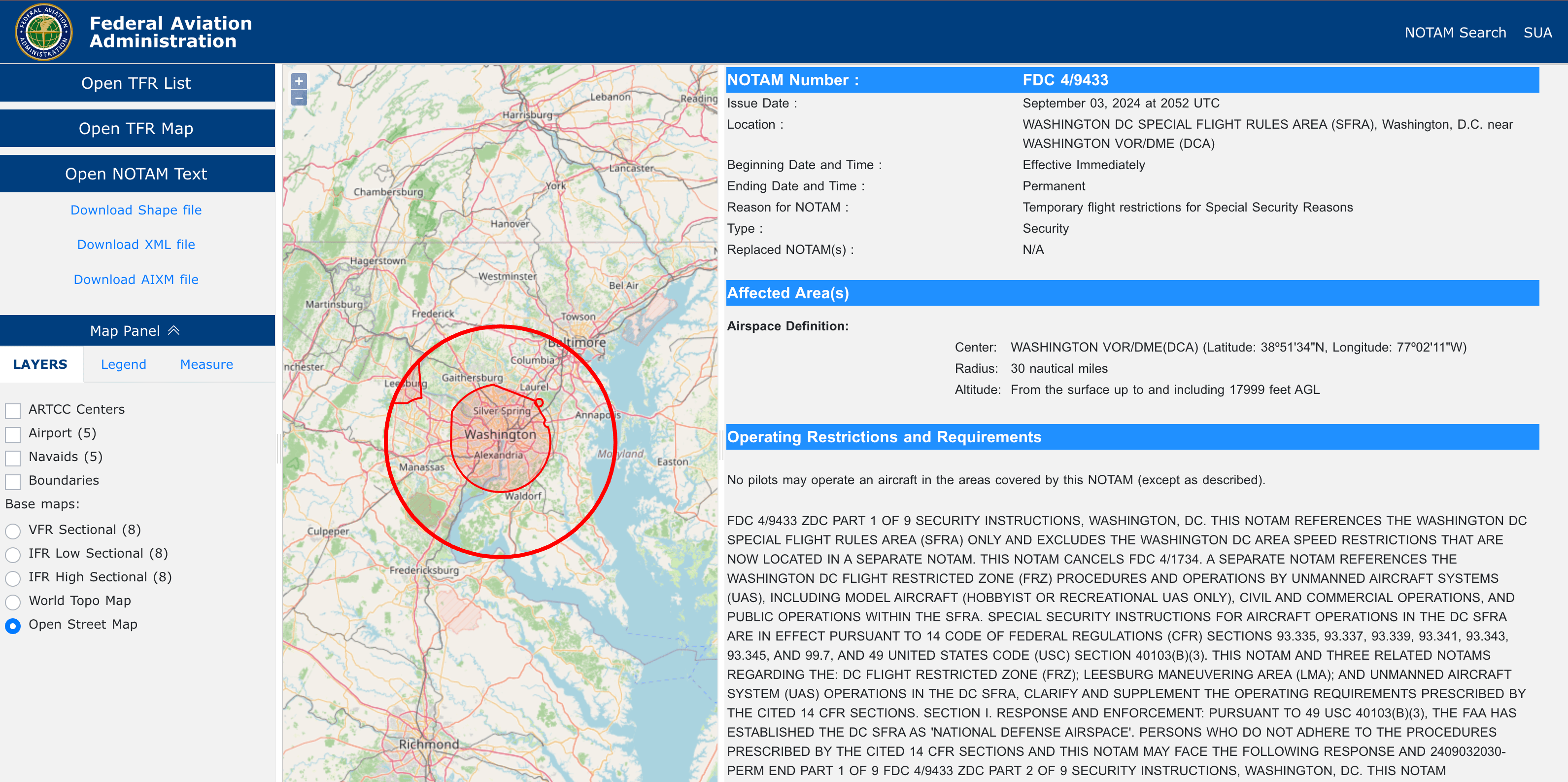
An Air Defense Identification Zone (ADIZ) facilitates early identification of all aircraft in
the vicinity of a nation’s airspace boundaries.
You must have
- file an IFR or defense VFR (DVFR) flight plan
- Mode C transponder
- two-way radio communication
to enter or exit an ADIZ.
Washington DC Special Flight Rules Area (SFRA)
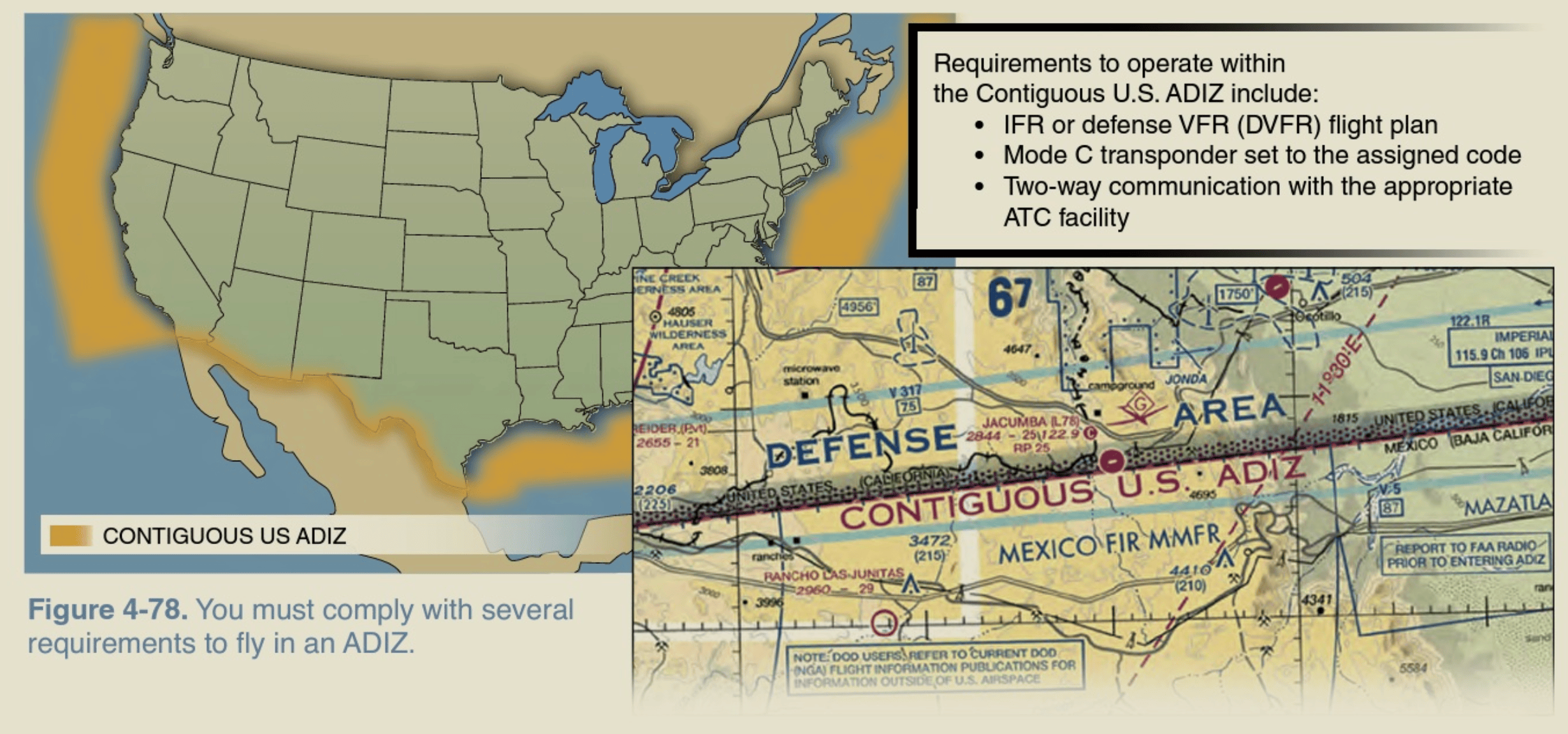
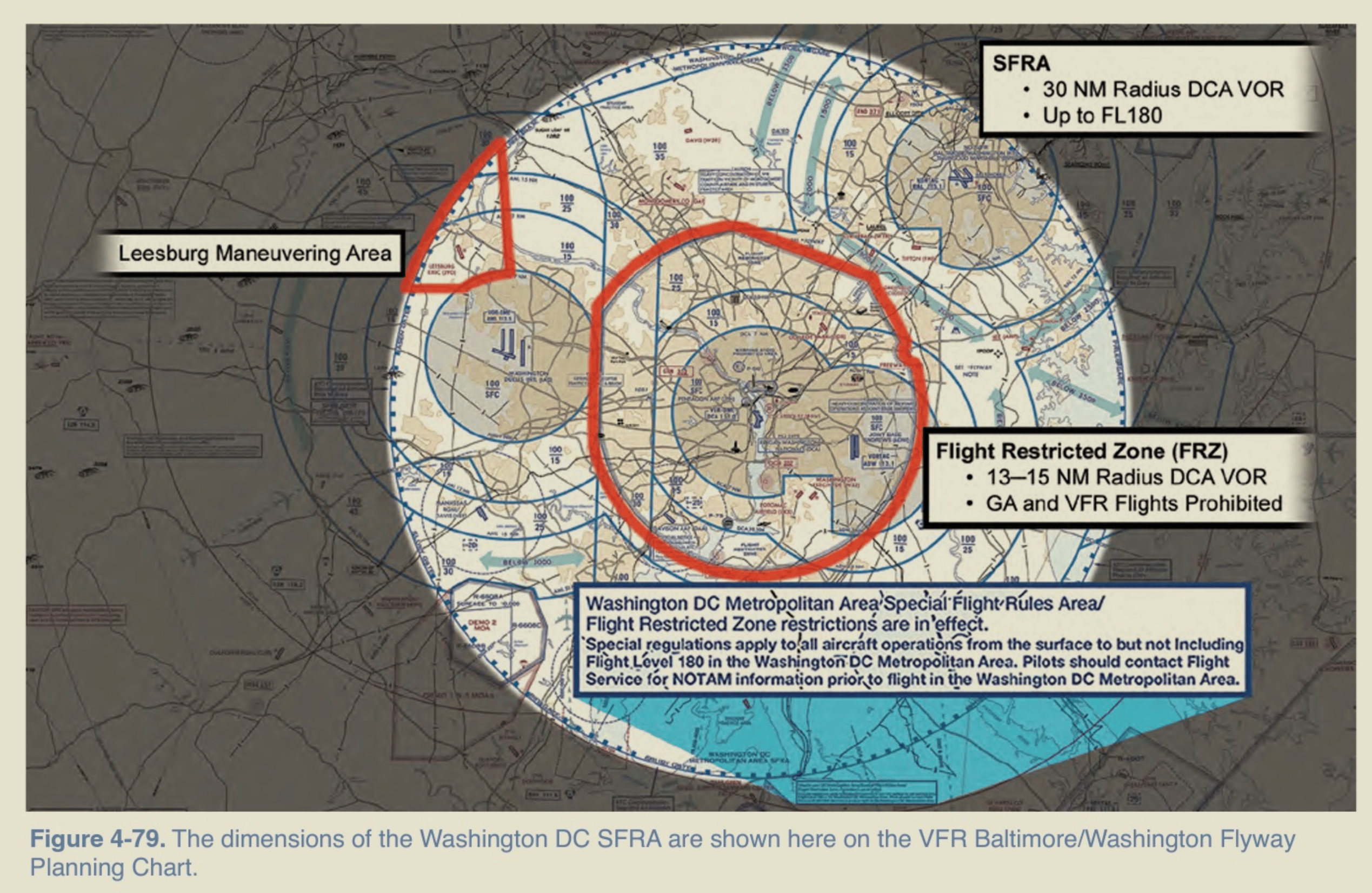
The Washington DC Special Flight Rules Area (SFRA) is airspace where the ready
identification, location, and control of aircraft is required in the interests of national security. Depicted on charts, the SFRA includes all airspace within a 30 nautical mile radius of the Washington DC VOR (DCA) from the surface up to but not including flight level 180 (FL180).
This includes areas with additional requirements: the Leesburg Maneuvering Area with its own special procedures, and the flight restricted zone (FRZ) -a highly-restricted ring of airspace within 13 to 15 nautical miles of the Washington DC VOR, which is directly over the nation’s capital. Only specially authorized aircraft may fly in the FRZ under IFR flight plans. Flight under VFR and general aviation aircraft operations are prohibited.
Special VFR
When the weather is below these VFR minimums, and there is no conflicting IFR traffic, a special VFR (SVFR) clearance may be obtained from the ATC. A special VFR clearance allows you to operate within the surface areas of Class B, C, D, or E airspace if the visibility is at least 1 statute mile (1sm) and you can remain clear of clouds.
You may NOT operate under a special VFR clearance at night unless you are instrument rated (IR) and your aircraft is instrument equipped.
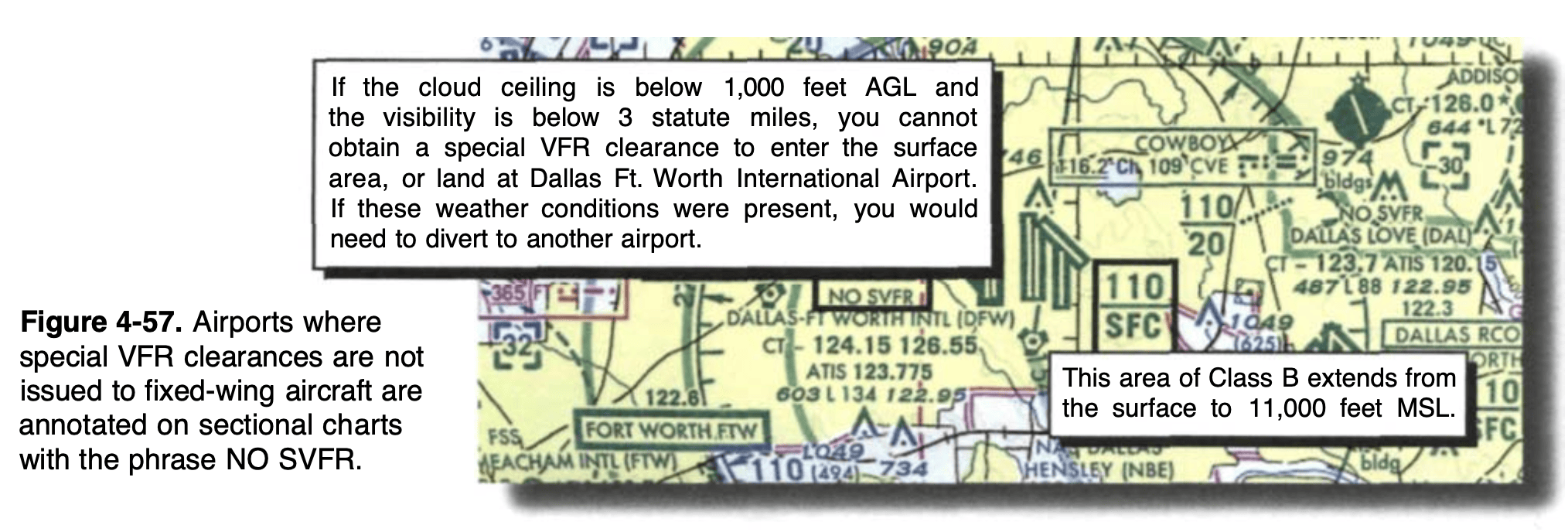
Airports where SVFR clearances are not issued to fixed-wing aircraft are annotated on sectional charts with the phrase NO SVFR.
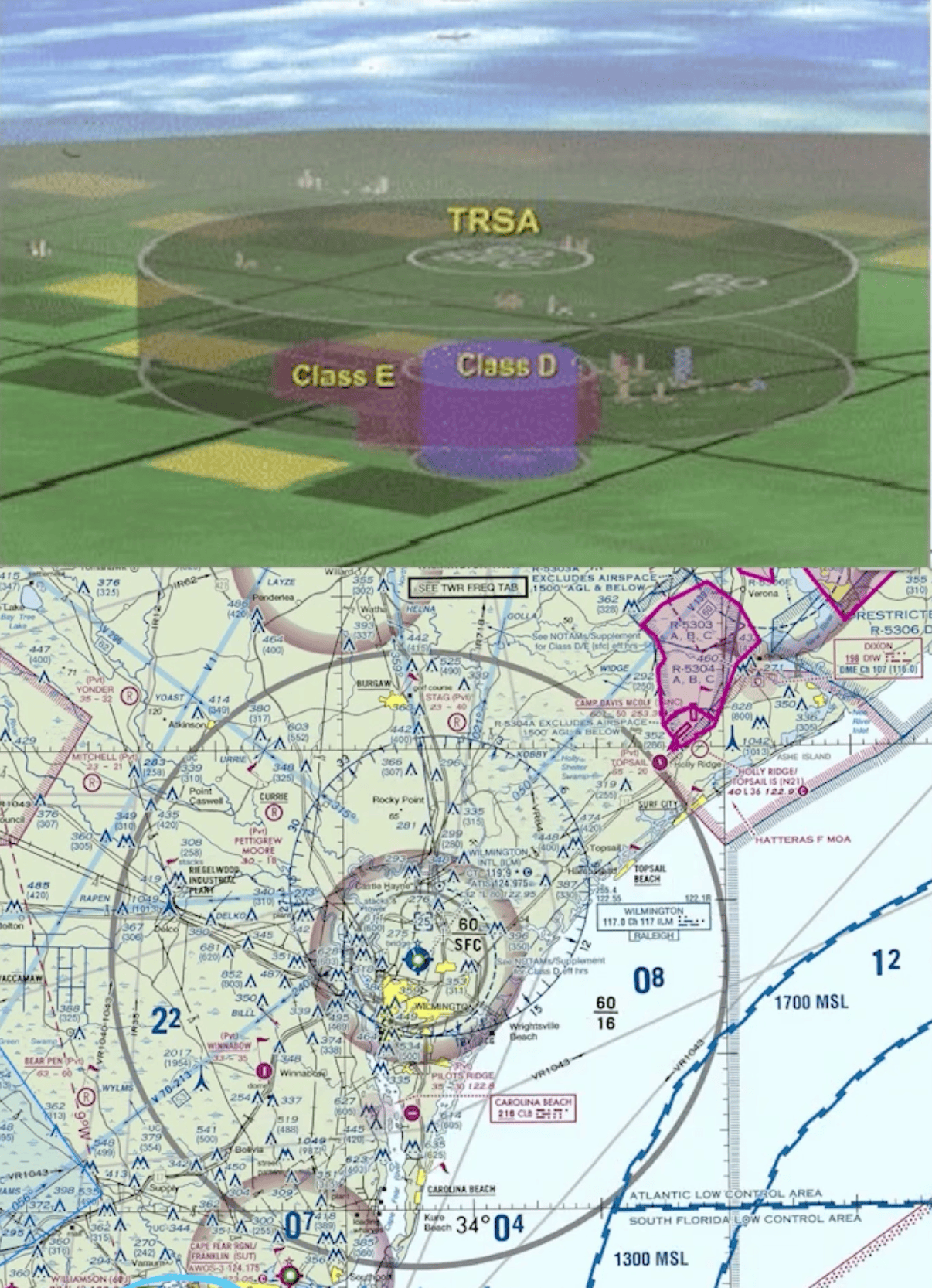
Terminal Radar Service Areas (TRSAs)
Terminal radar service areas (TRSAs) do not fit into any of the U.S. airspace classes.
Originally part of the terminal radar program at selected airports, TRSAs have never
been established as controlled airspace and, therefore, FAR Part 91 does not contain any rules for TRSA operations. By contacting approach control, you can receive radar
services within a TRSA, but participation is voluntary.
TRSA is generally seen:
- Class D Airport(s) within the TRSA.
- TRSA oversees Class E Airspace 700’ or 1,200’ AGL
- Solid black line