Air Masses
An air mass is a large body of air with generally uniform temperature and moisture characteristics., and some of these air masses may cover as much as a continent, or half of a continent, or at least several states.
How do these air masses form? We need two key things:
- An extensive area that is geographically uniform.
- A region dominated by a general stagnation of atmospheric circulation.
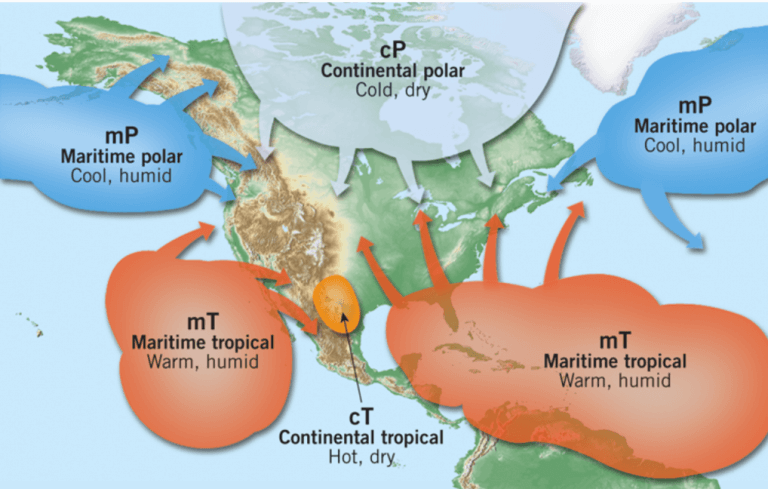
When that happens, the air over a particular geographical region will be able to pick up the characteristics of that region. We label those according to those characteristics, as the following diagram shows:
Naming Patterns
- How does the air mass stagnates?
- Maritime (m): If the air mass stagnates over the ocean.
- Continental (c): If the air mass stagnates over the continent.
- How close is that air mass to the equator or the pole?
- Polar (P): If the air mass is closer to the pole.
- Tropical (T): If the air mass is closer to the equator.
E.g.
- Maritime tropical (mT),
- Continental tropical (cT),
- Maritime polar (mP),
- Continental polar (cP), and
- Continental arctic (cA)
Fronts
A Front is a essentially a boundary or transition zone between two air masses.
The Cold Front
A cold front occurs when a cold air mass overtakes a warmer air mass.
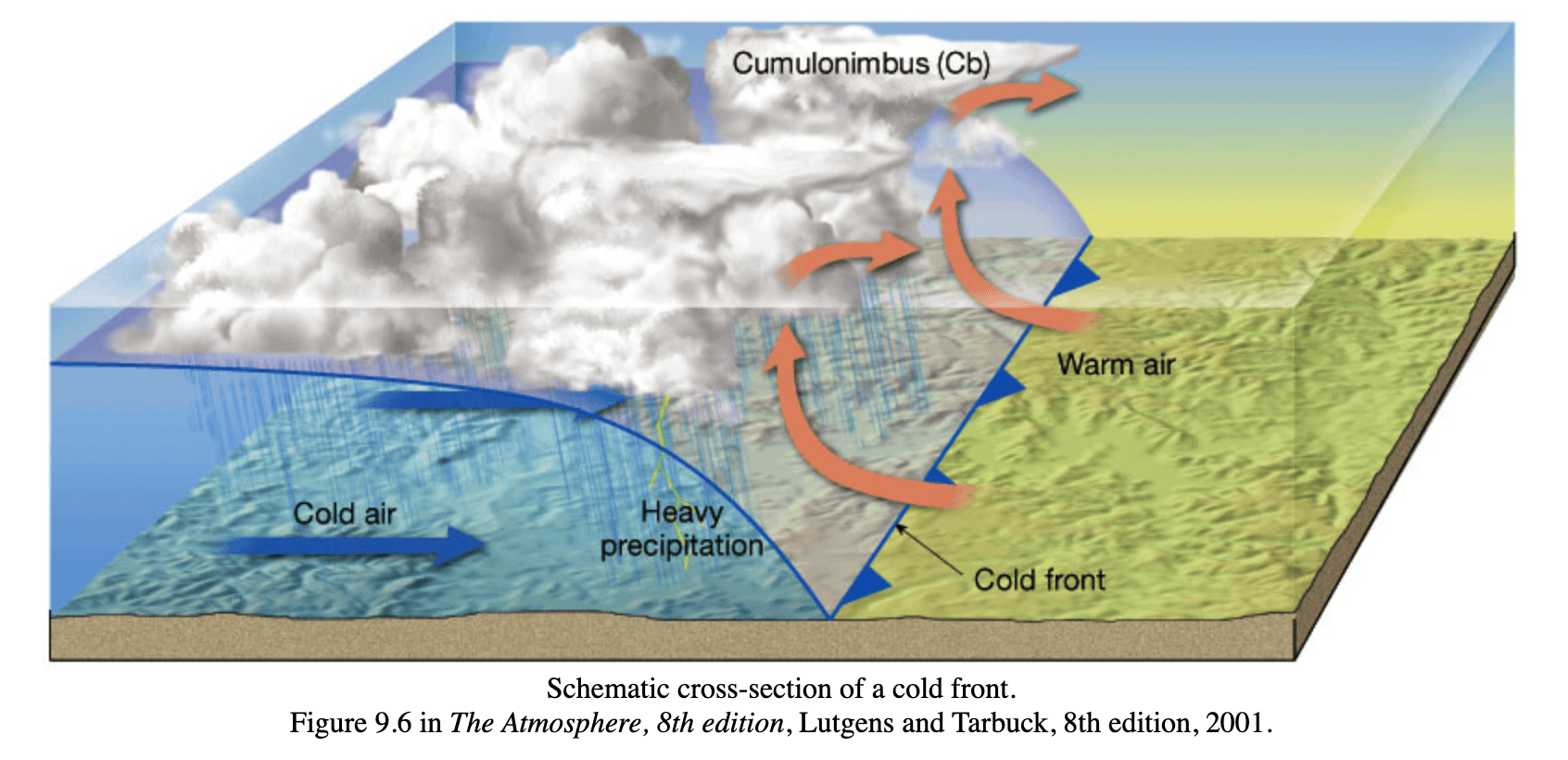
- Fast Moving (typically 20 to 30 mph, though powerful ones can reach 50 to 60 mph).
- Lifting Action: The cold air acts as a wedge, forcing the moist, warm air to rise rapidly.
- Narrow in width: 50 - 200 miles
- Weather Condition:
- Cumuliform clouds,
- Cumulonimbus (thunderstorms),
- Unstable air,
- Turbulence.
The Warm Front
A warm front occurs when warm air displaces cooler air.
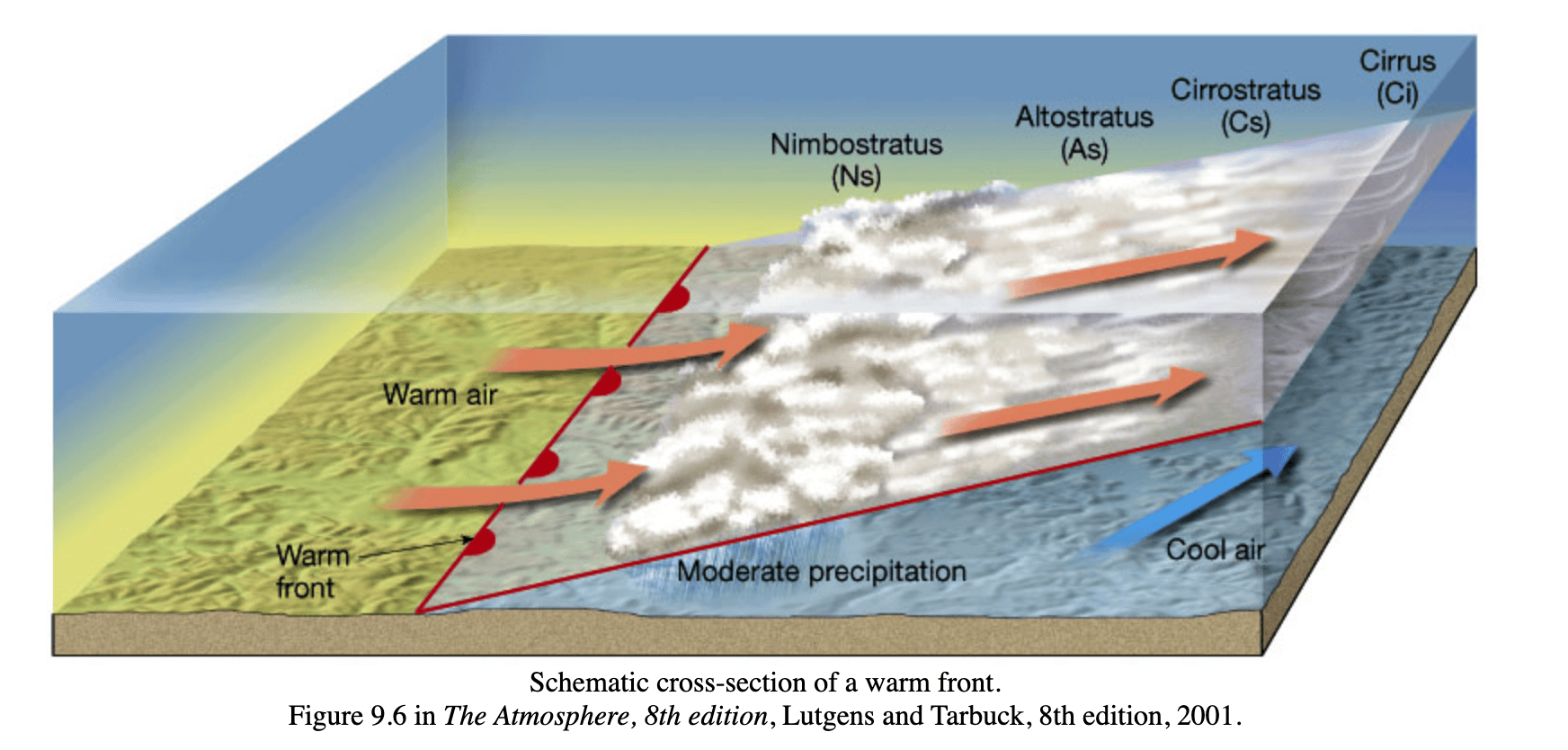
- Speed: They tend to move slower because warm air naturally wants to rise, making it harder to “push” the heavy cold air out of the way.
- Lifting Action: The warm air slides up over the top of the cold air mass (a gradual slope).
- Weather Condition: Because the air aloft is warmer, stability is usually neutral or positive.
- Stratiform clouds,
- wide areas of rain/drizzle (generally not thunderstorm)
- generally stable air,
- smooth flying conditions,
- poor visibility.
The Stationary Front
A stationary front occurs when the forces of two air masses are relatively equal, the boundary or front that separates them remains stationary and influences the local weather for days.
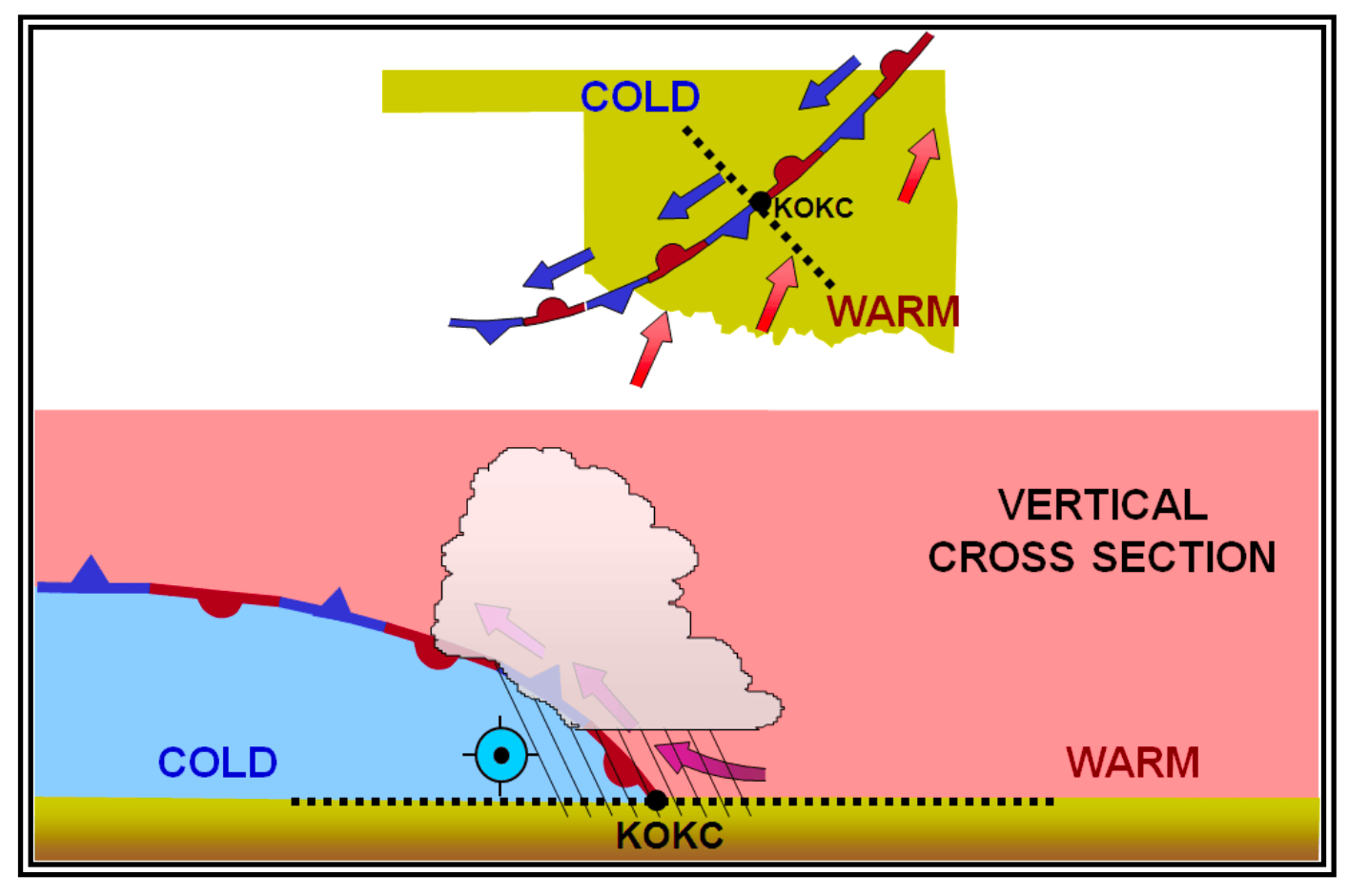
- Contain characteristics of both cold & warm fronts
- Thunderstorms are possible.
- large areas of stratus clouds, commonly Instrument Meteorological Conditions (IMC)
The Occluded Front
An occluded happens when the air continues to move, but one air mass overtakes the one in front of it. Since cold fronts typically moves faster than warm fronts, the cold air undercuts the retreating cooler air mass associated with the warm front, further lifting the already rising warm air.
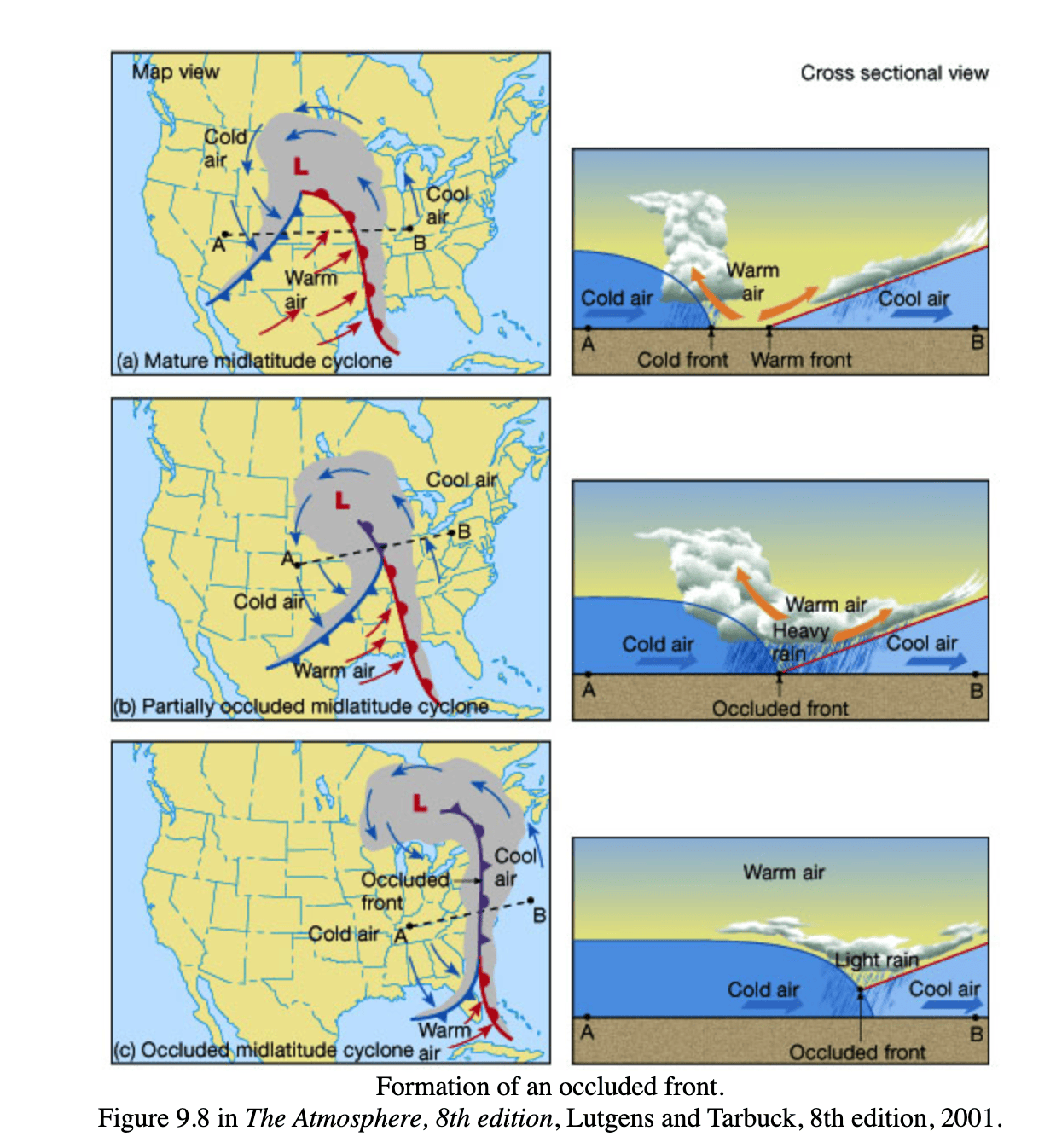
Occluded front typically happens in three stages:
- A cold air mass and a warm air mass are moving, with characteristic clouds still separated.
- The cold air starts to overtake and literally “run over” the warm air. The symbols combine into purple alternating triangles and half-circles. You get a mix of cumuliform and stratiform clouds, with a variety of precipitation.
- The cold air has completely taken over the warm air, and the occlusion is well-established.
Keynotes
- Air Mass: A large body of air with generally uniform temperature and moisture characteristics.
- Front: The boundary or transition zone between two different air masses.
- Cold Front: A front where cold air replaces warm air; associated with violent weather and fast movement.
- Warm Front: A front where warm air replaces cold air; associated with steady precipitation and slow movement.
- Stationary Front: when the forces of two air masses are relatively equal, the boundary or front that separates them remains stationary.
- Occluded Front: A complex front formed when a fast-moving cold front catches up to a slow-moving warm front, lifting the warm air completely off the ground.
- Name two things that are necessary for an air mass to form.
- An extensive, uniform geographical area.
- A region dominated by general stagnation of atmospheric circulation.