Clouds, Fog, and Precipitation
Cloud Categories by Altitude
We categorize clouds into four main categories: low, medium, high, and vertically developed. The fourth category—vertically developed—is unique because these clouds cross through the low, medium, and high altitudes.
Based on the FAA’s Advisory Circular on Aviation Weather, we define these altitudes at temperate latitudes (roughly 25° to 35°):
- Low Clouds: Surface to 6,500 feet.
- Middle (Alto) Clouds: 6,500 feet to 23,000 feet.
- High (Cirrus) Clouds: Above 23,000 feet (can start as low as 16,500 feet).
Cloud Forms: Stability and Appearance
Clouds generally form into one of two basic shapes depending on the stability of the air:
- Strati-form: If the air is stable, clouds tend to stay relatively level and flat.
- Nimbo-form : A combination of both stratus and cumuliform. “Nimbus” is Latin for rain. These are typically more stratiform but are full of moisture; we think of them as rain clouds.
- Cumuli-form: If the air is unstable, clouds billow, puff, and move vertically.
Identifying Cloud Types
By combining the altitude (prefix) with the cloud form (suffix), we can identify specific types:
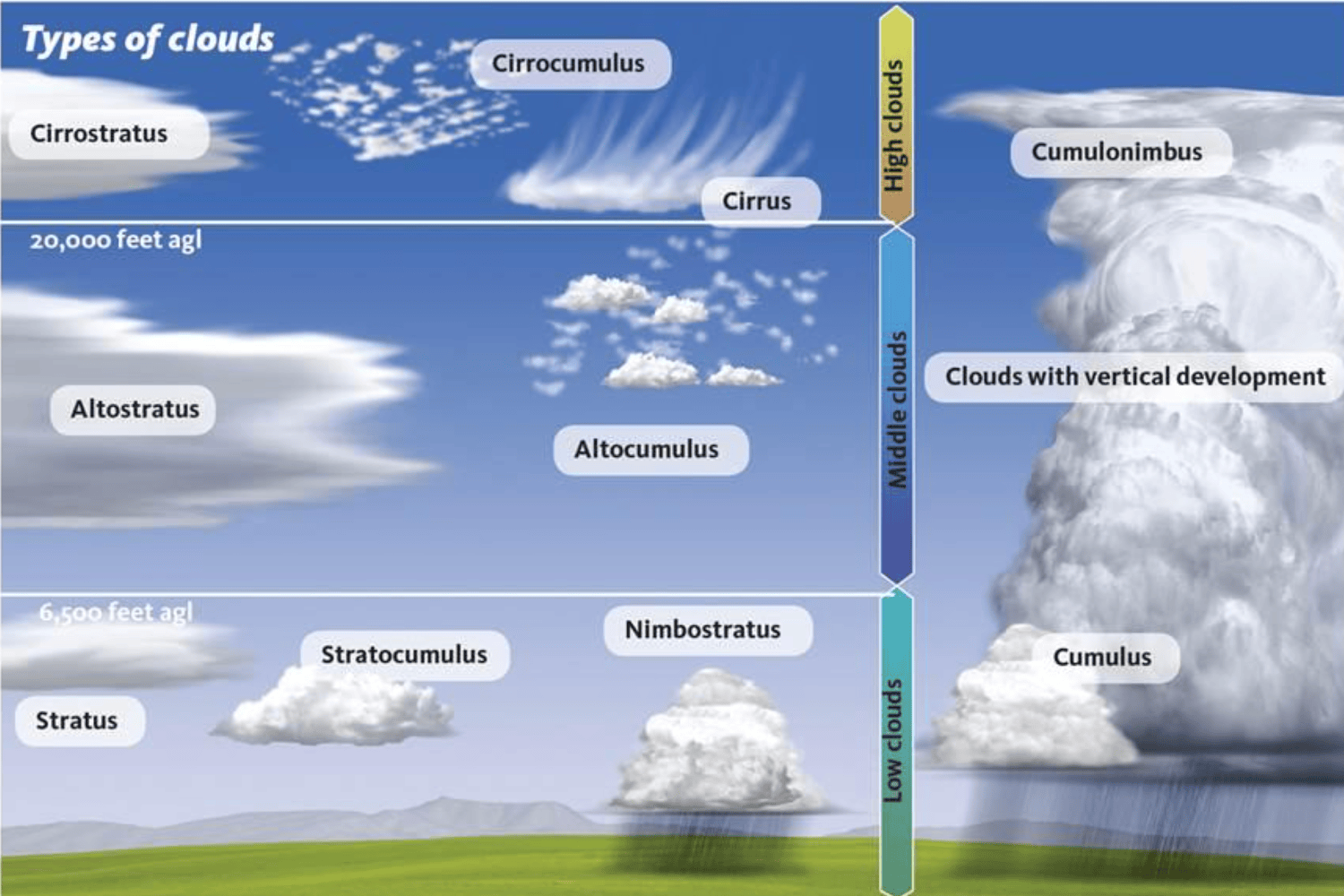
Low-level Clouds (< 6,500 ft)
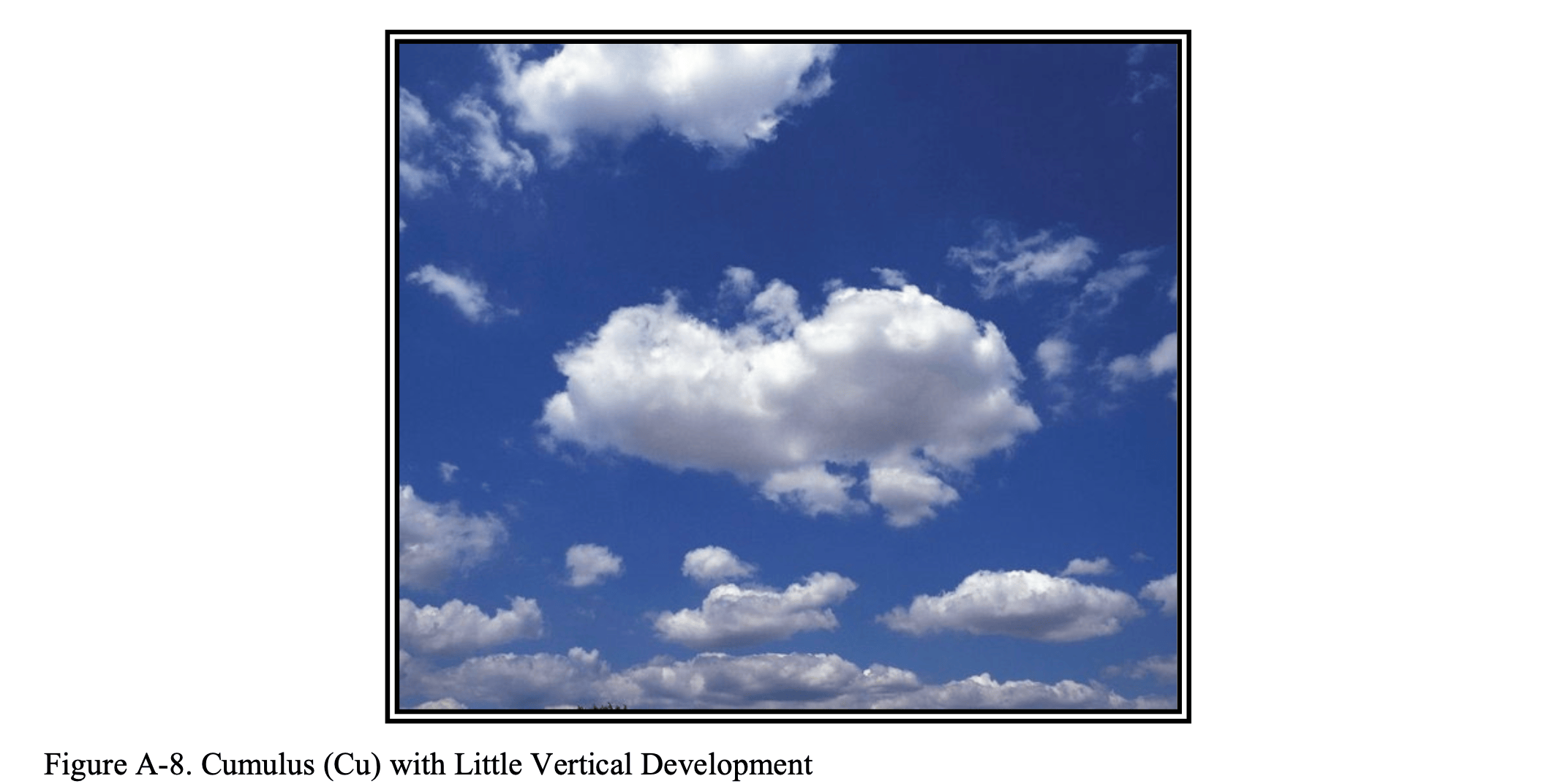
- Cumulus (Cu): Puffy, billowy clouds associated with unstable air and vertical movement.
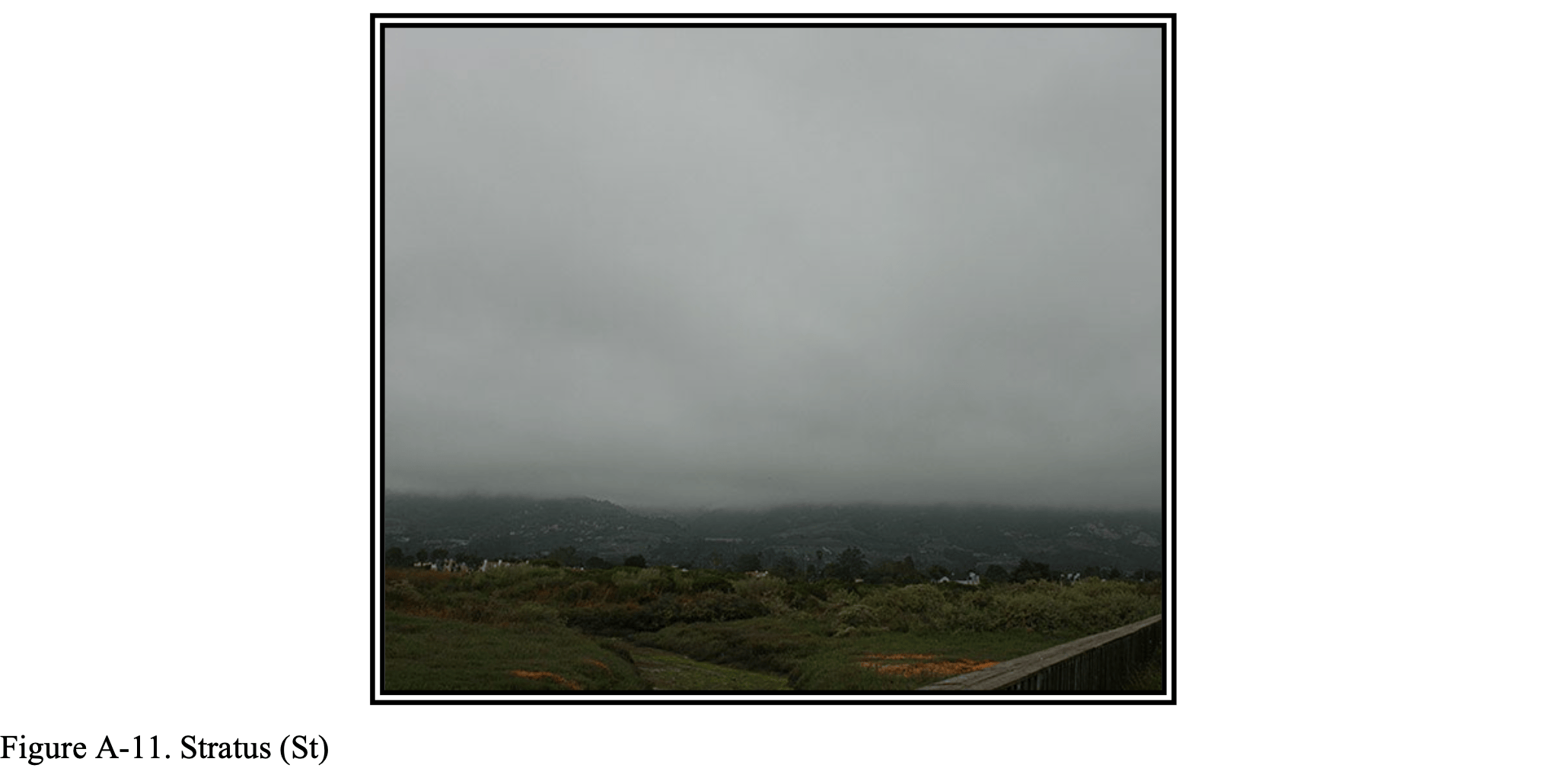
- Stratus (St): Flat, level, and sheet-like clouds associated with stable air.
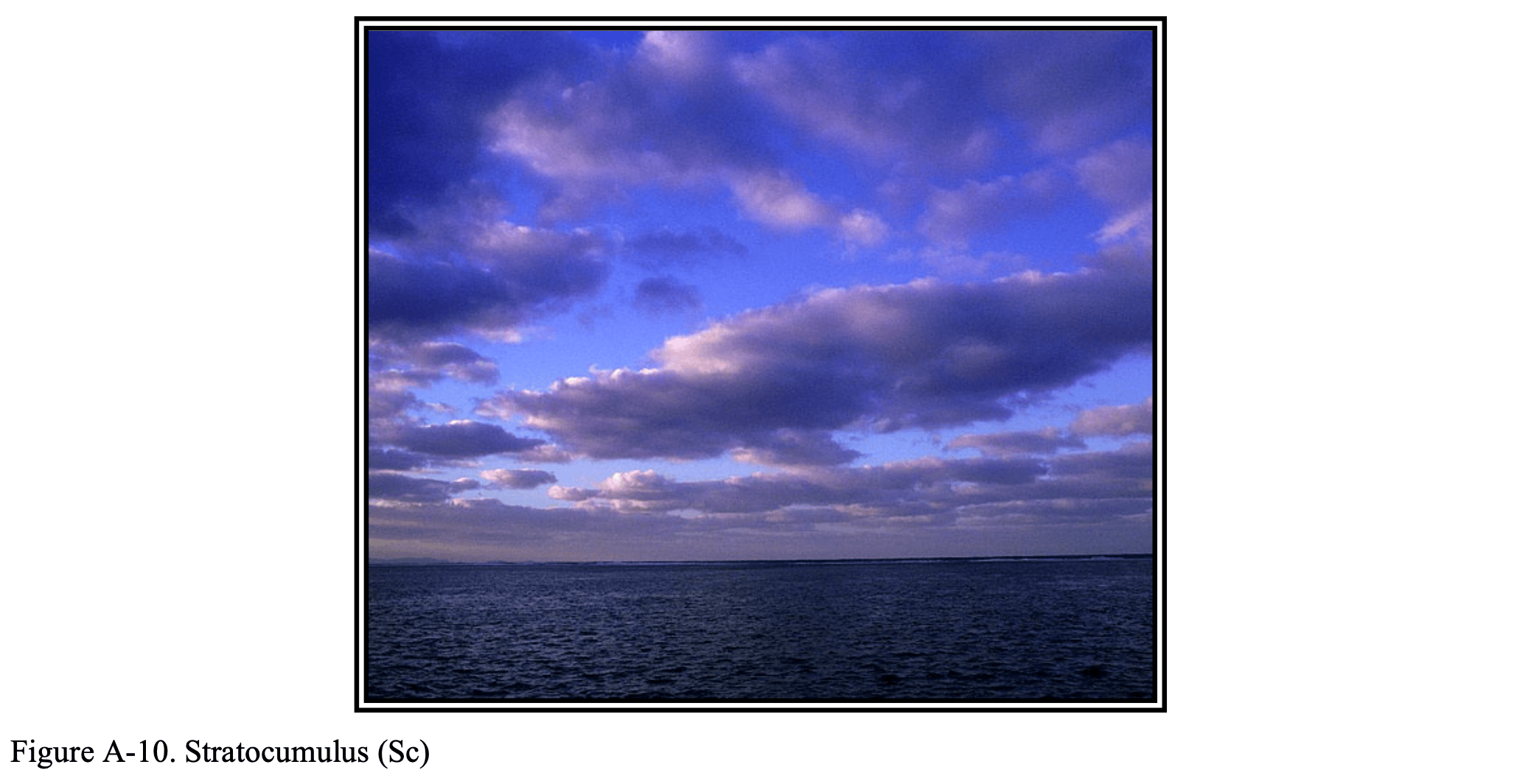
- Stratocumulus (Sc): A blend of the two above.
- Nimbostratus (Ns): - Thick, gray, moisture-laden layers that produce steady, continuous precipitation.
- The type is referred to as mid-level clouds in Aviation Weather Handbook (FAA-H-8083-28A)
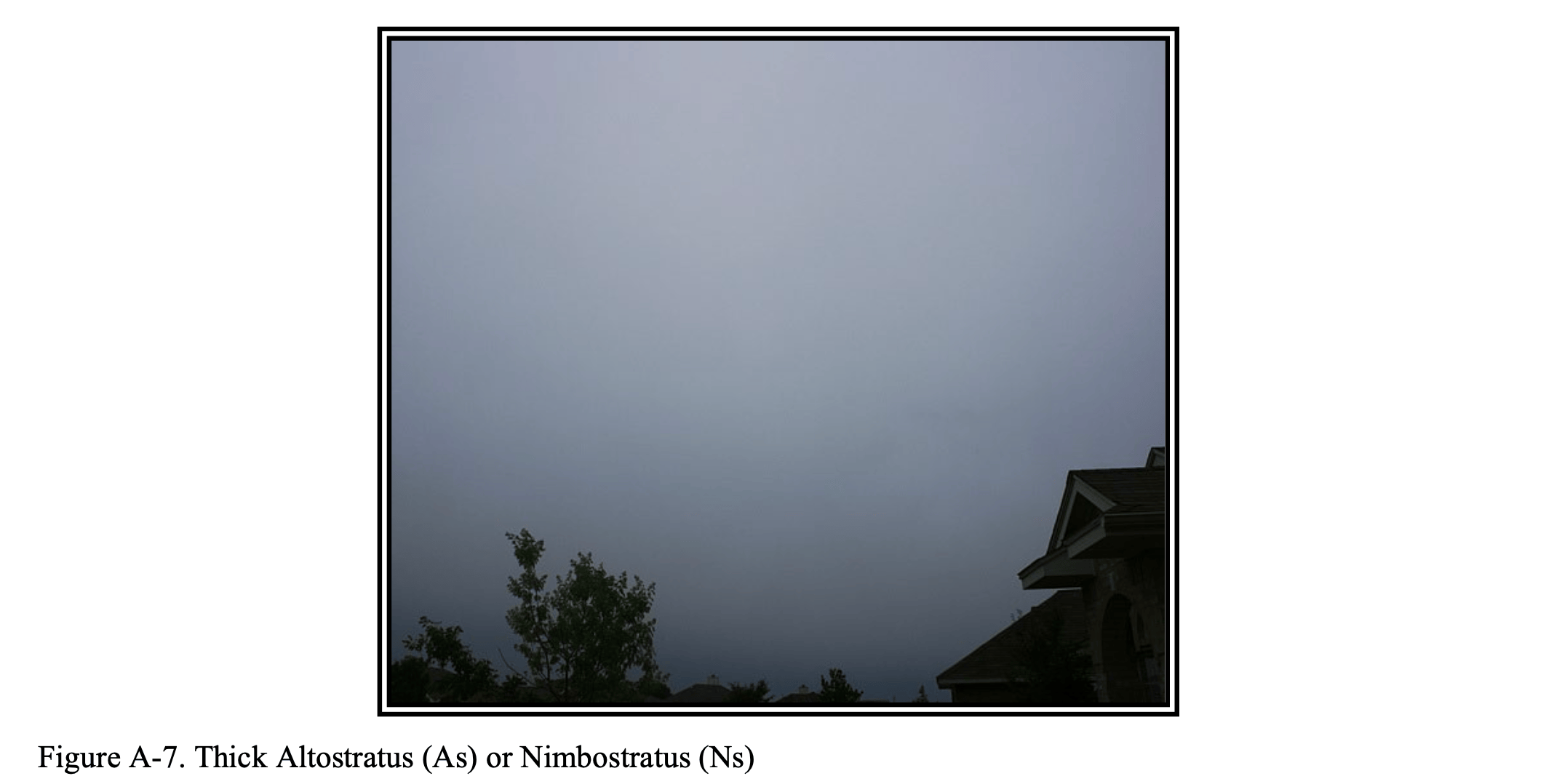
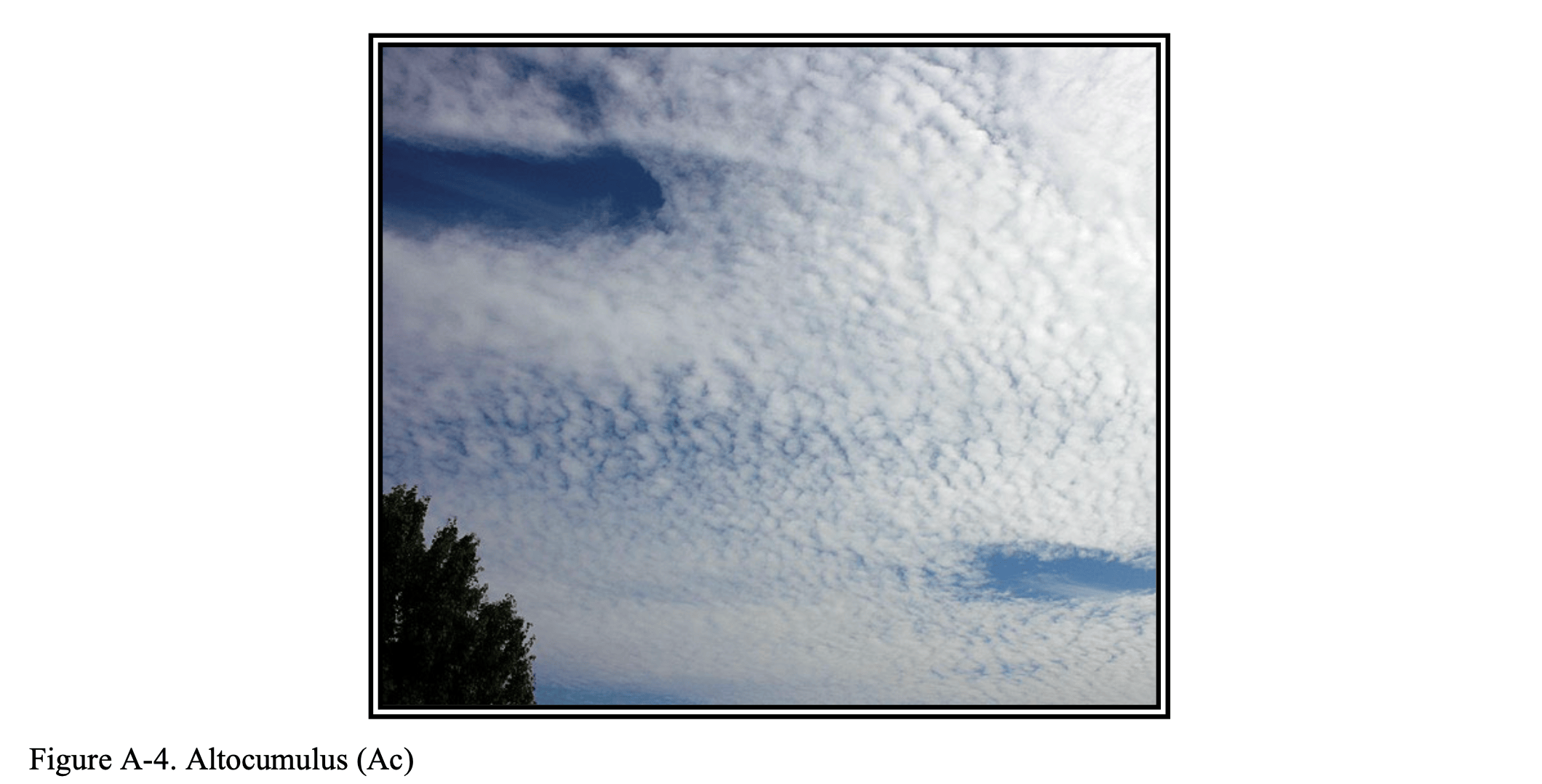
Mid-level (Alto-) Clouds (6,500 ~ 23,000 ft)
- Altocumulus (Ac): Mid-level puffy or “heaped” clouds, often appearing as patches or sharplyoutlined masses.
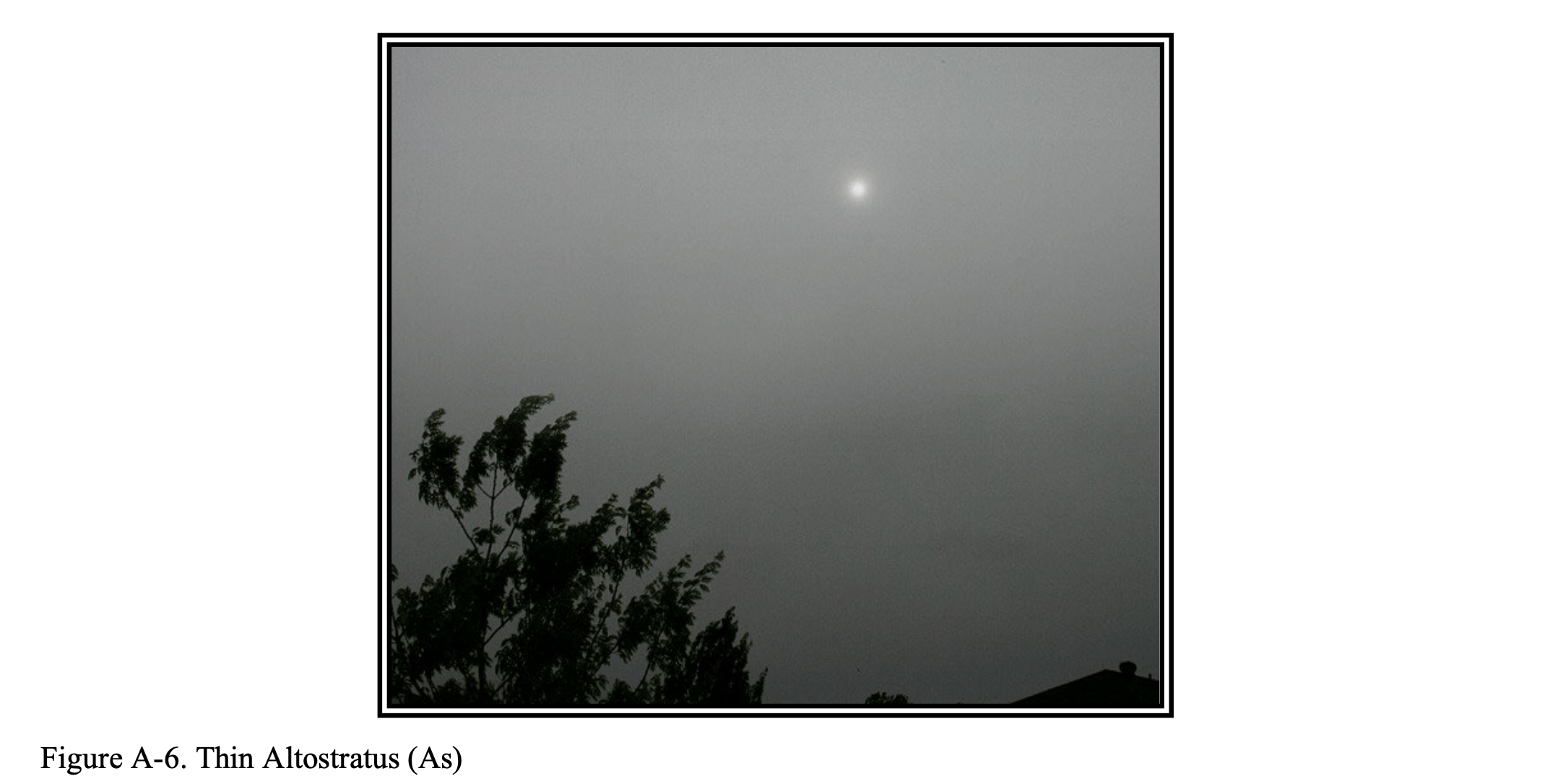
- Altostratus (As): Mid-level form of a gray or bluish (never white) flat sheets that typically cover the entire sky.
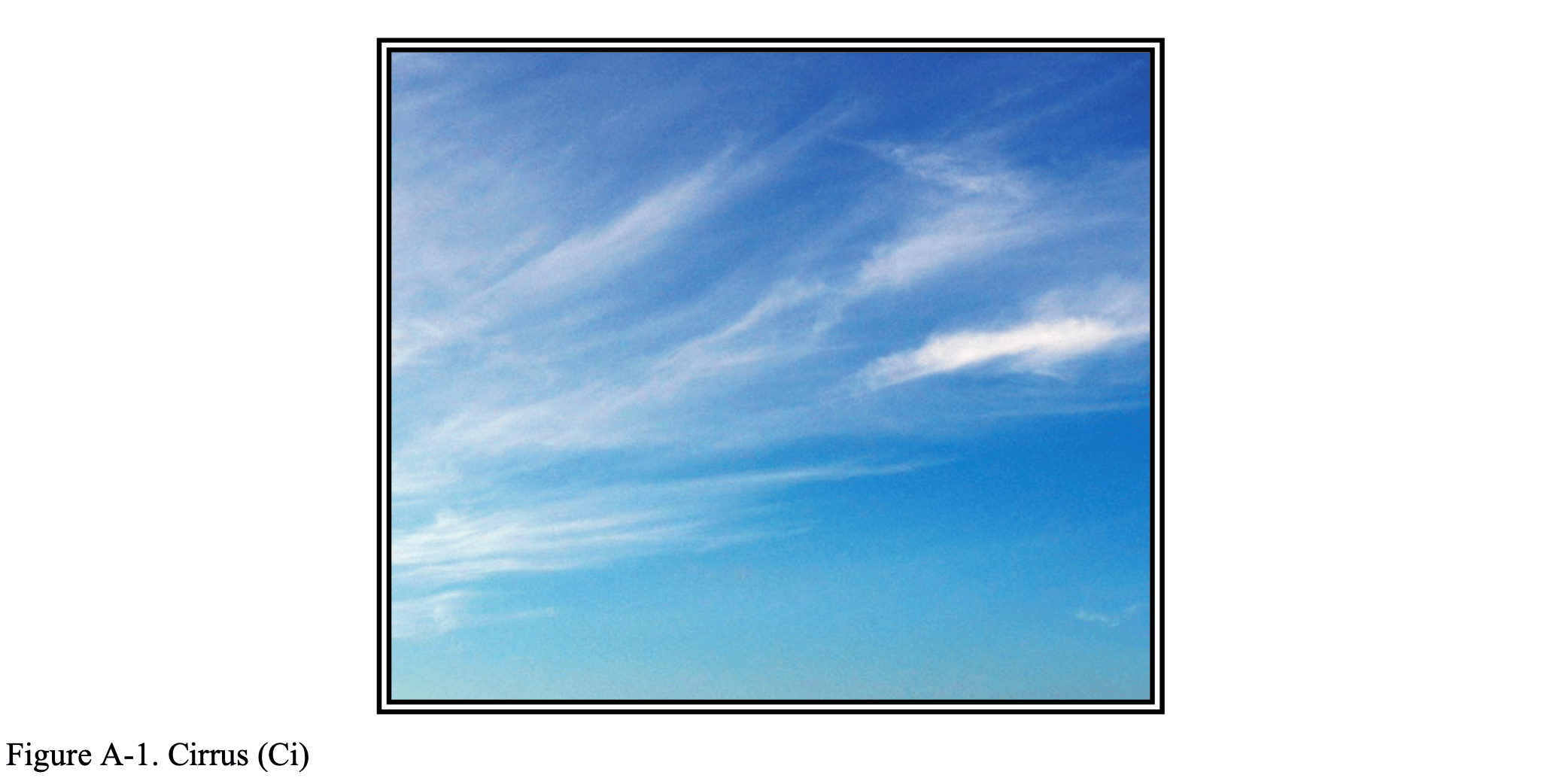
High-level (Cirrus-) Clouds (> 23,000 ft)
- Cirrus (Ci): Thin, “Cirri-form” clouds composed of ice crystals.
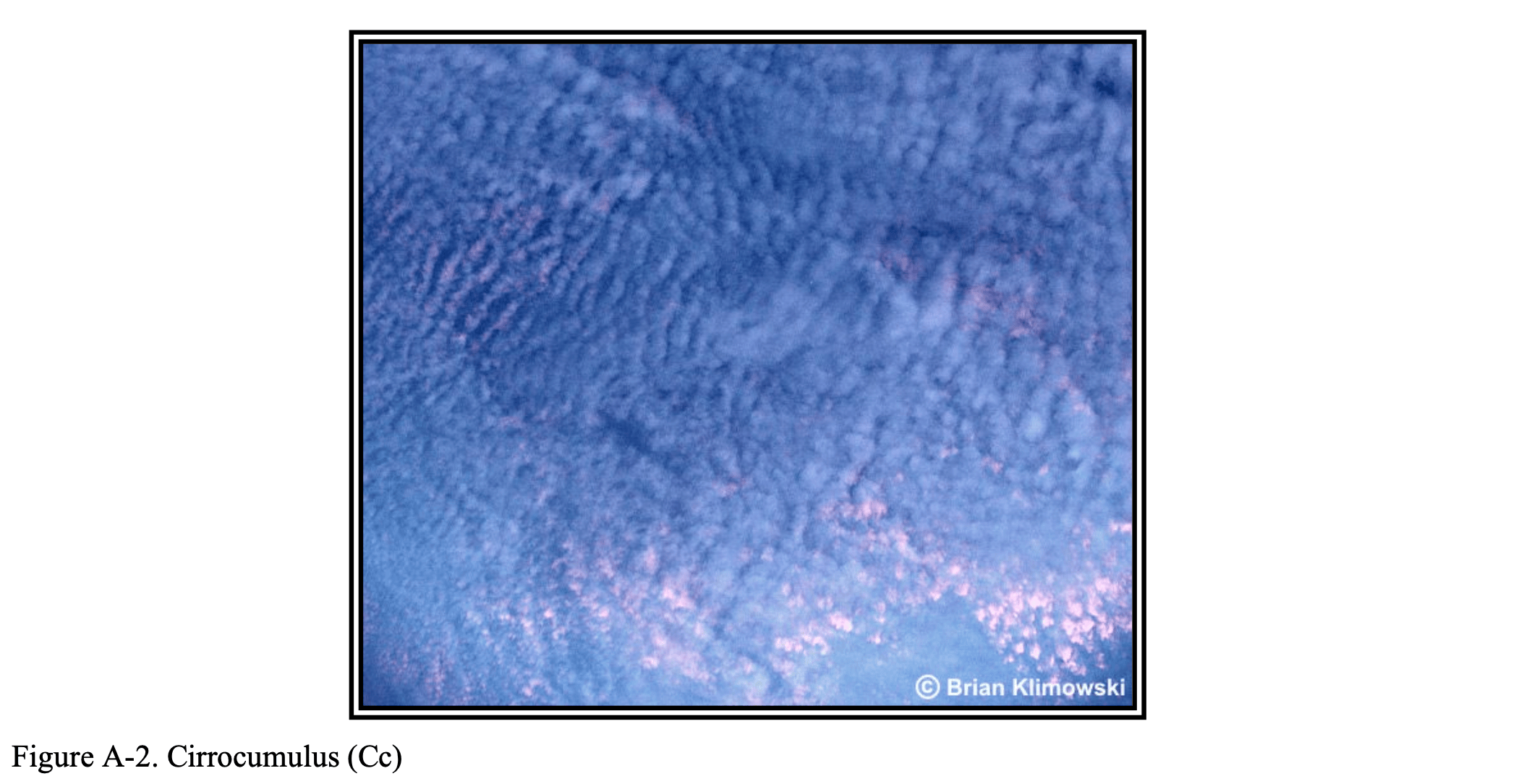
- Cirrocumulus (Cc): High-level puffy clouds. cirri-form cloud type appearing as a thin white patch, sheet, or layer of cloud without shading and is composed of very small elements in the form of grains, ripples, etc.
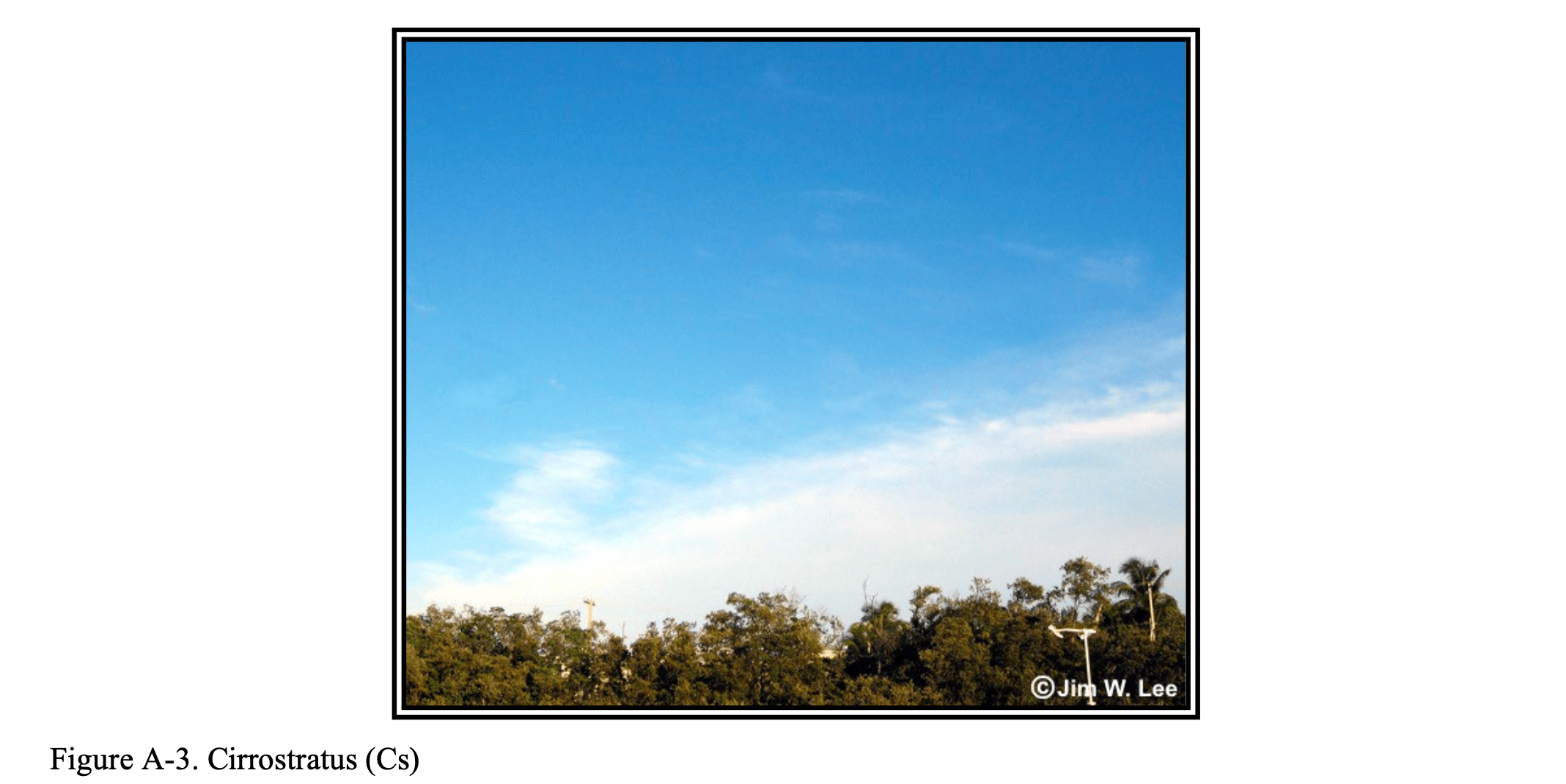
- Cirrostratus (Cs): High-level flat, thin veils. cloud type appearing as a whitish veil and is usually fibrous (hairlike) but sometimes smooth
Vertically Developed Clouds
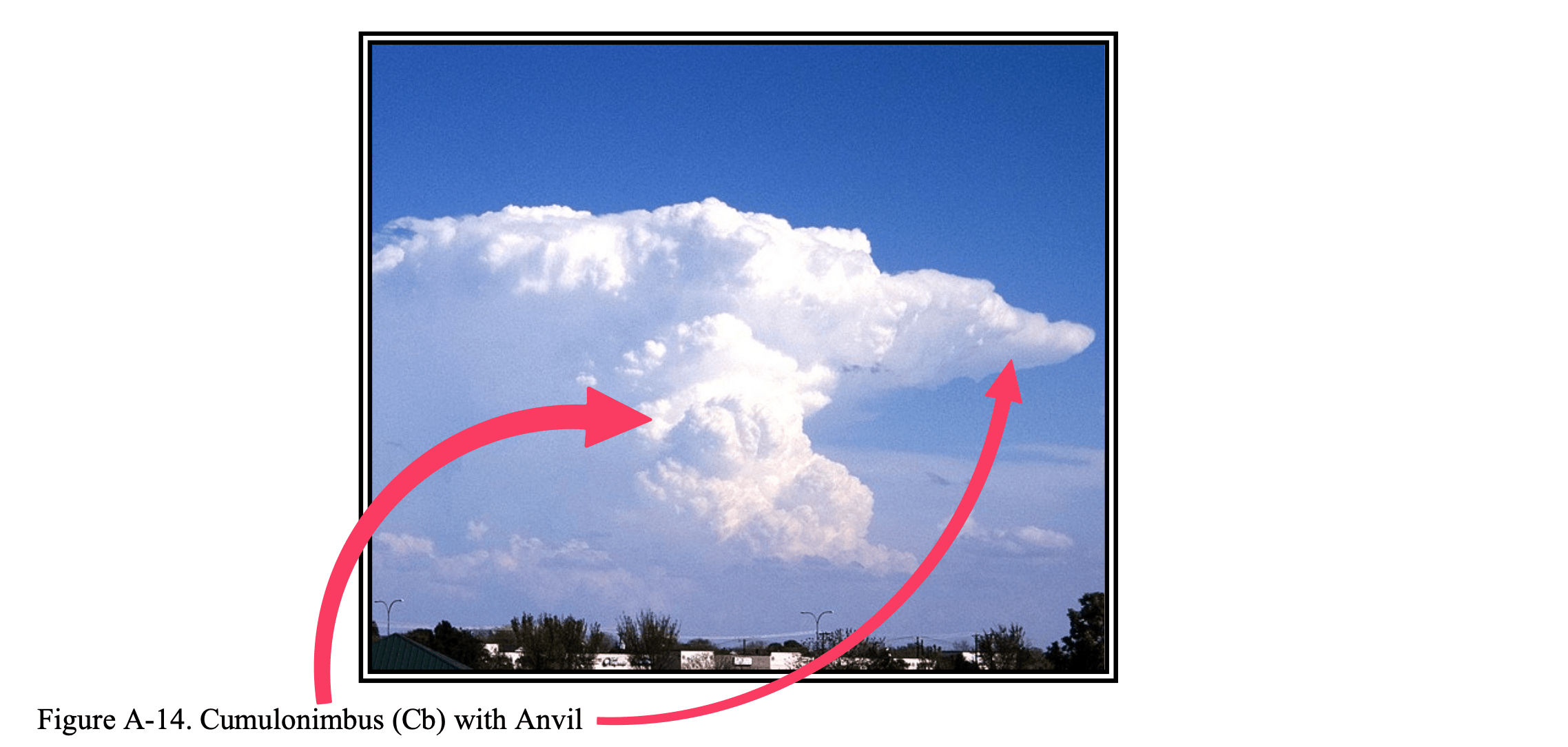
Cumulonimbus (Cb): Massive, towering clouds that cross all three altitude categories, often appears as mountains or huge towers, which may occur as an isolated cloud or an extensive wall and squalls, hail, and/or thunder often accompany them. *The tops of these massive clouds show a fibrous or striated structure that frequently resembles an anvil. *
Fog
Fog is a visible aggregate of minute water droplets that are based at the Earth’s surface, and it reduces horizontal visibility to less than 5/8 sm (1 km); unlike drizzle, it does not fall to the ground. Fog differs from a cloud only in that its base must be at the Earth’s surface, while clouds are above the surface.
Types of Fog
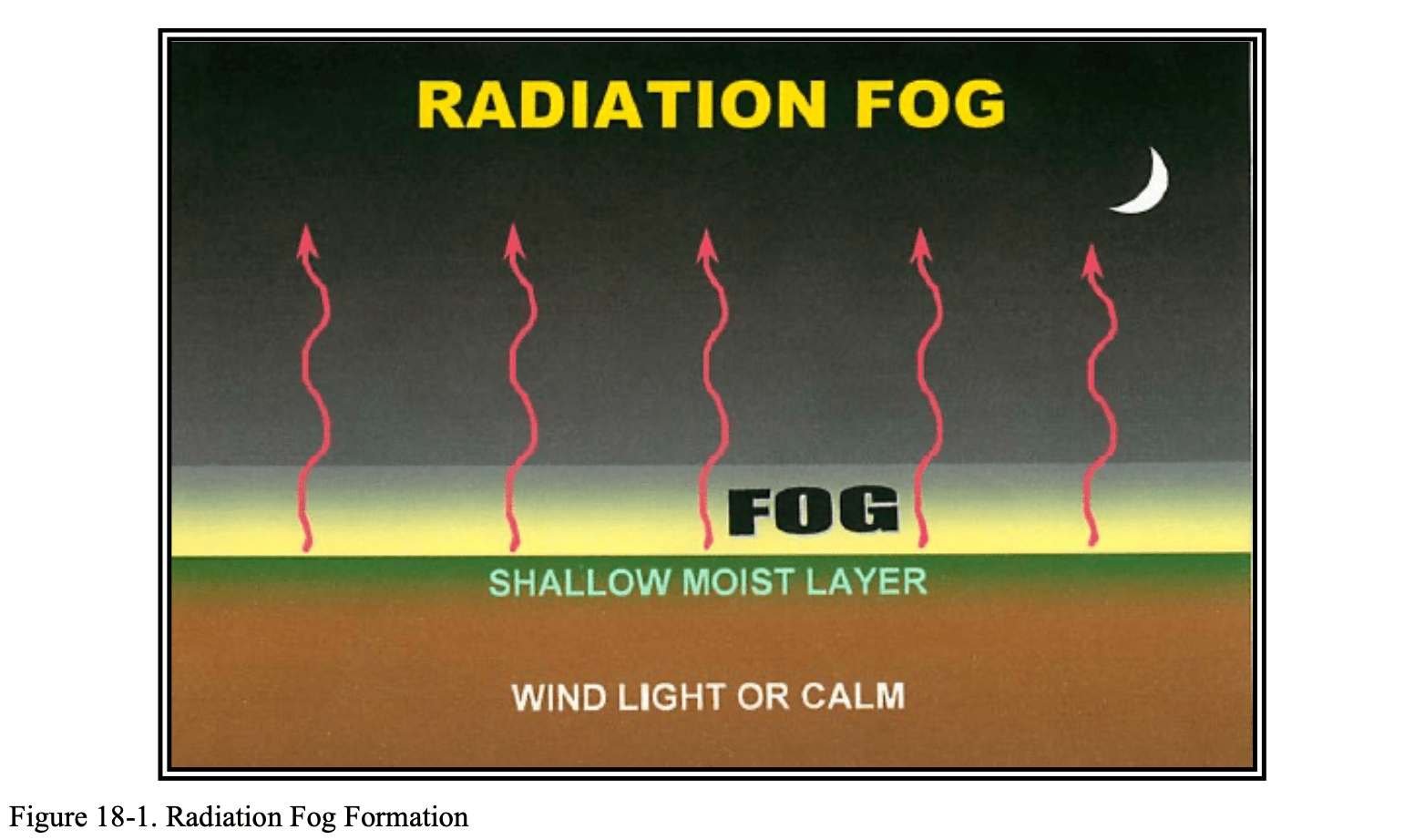
- Radiation Fog: The first one we see here is called radiation fog. That happens on a clear, calm, humid night. And take a look at what’s happening: the earth is losing heat by radiating the heat out into the atmosphere and into space, and as the earth cools, the air in contact with the earth cools and reaches the dew point.
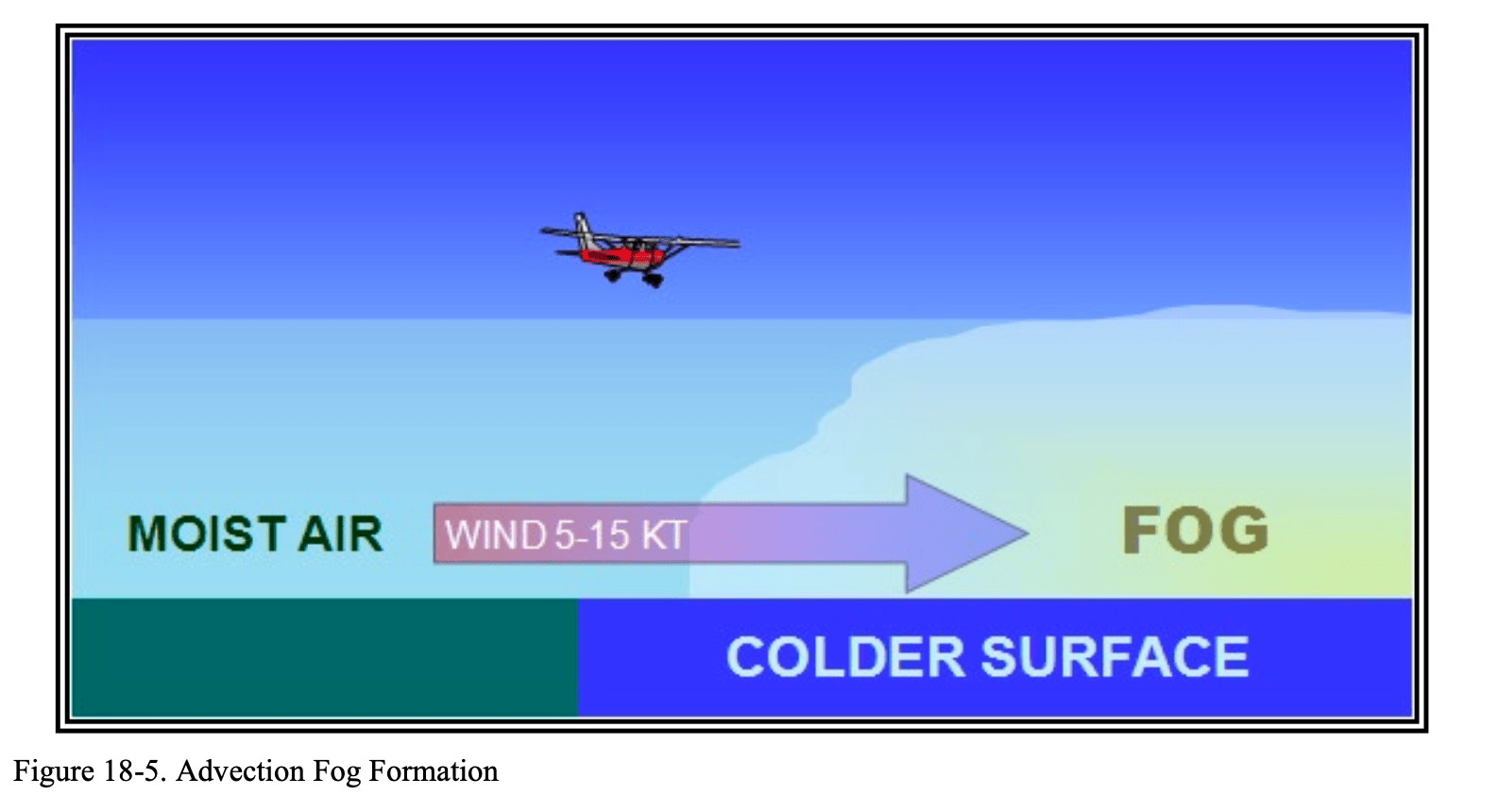
- Advection Fog: Take a look at the second one. The second one says advection fog. Now in meteorology, we have convection and advection. Convection moves vertically; advection moves horizontally. So if someone told us that we had warm, moist air from over the Atlantic Ocean maybe moving slowly westward over the cold, drier land, and that warm, moist air contacted that cool land and dropped its temperature, once again the temperature and dew point are equal. Fog forms, and it was a result of that horizontal movement.
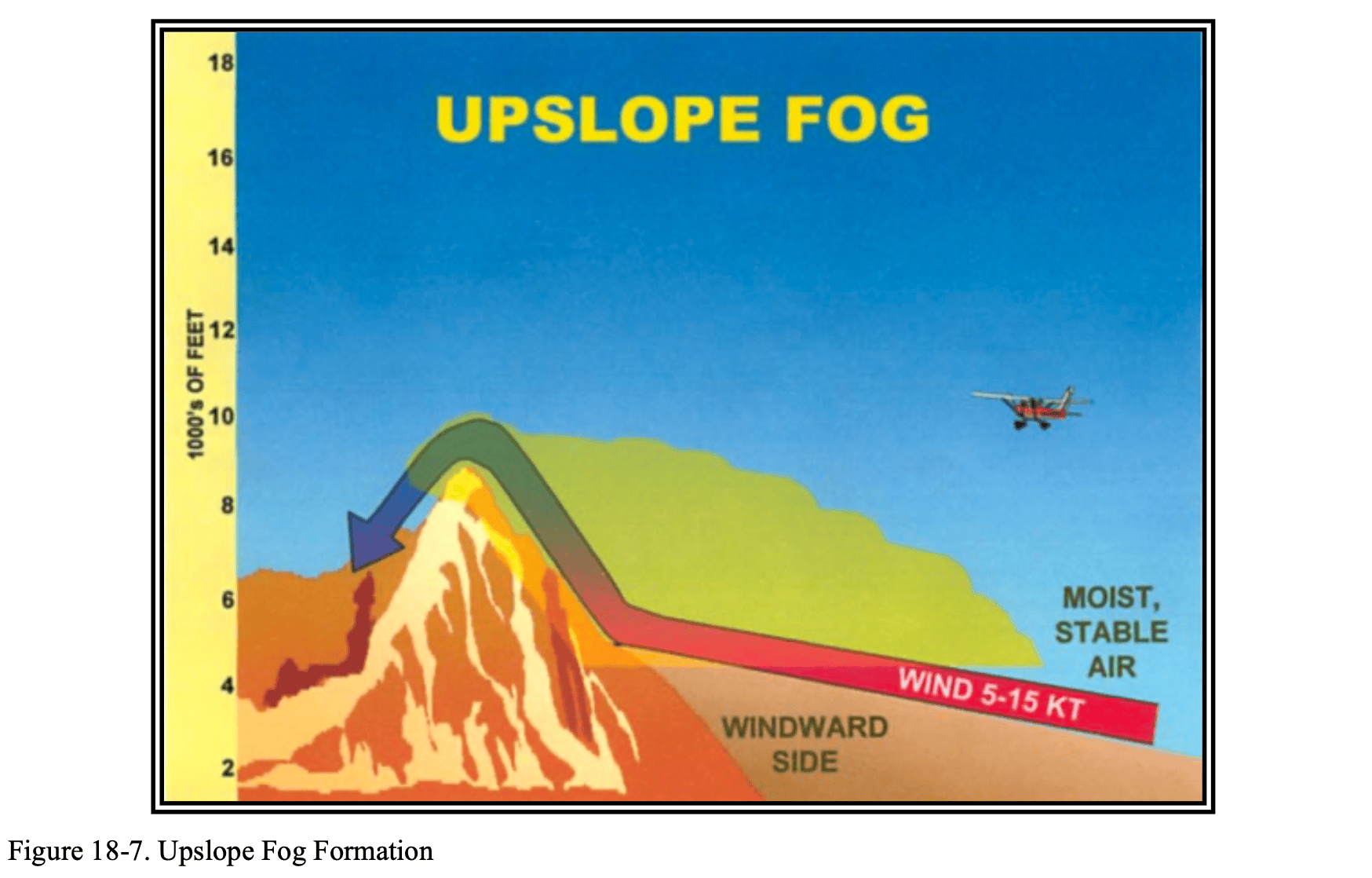
- Upslope Fog: Take a look at the third one: upslope fog. Upslope fog happens when this moist, stable air is forced up a hill, or up a mountain, or up a land mass. As it rises, it cools adiabatically. It cools to the dew point. That’s upslope fog.
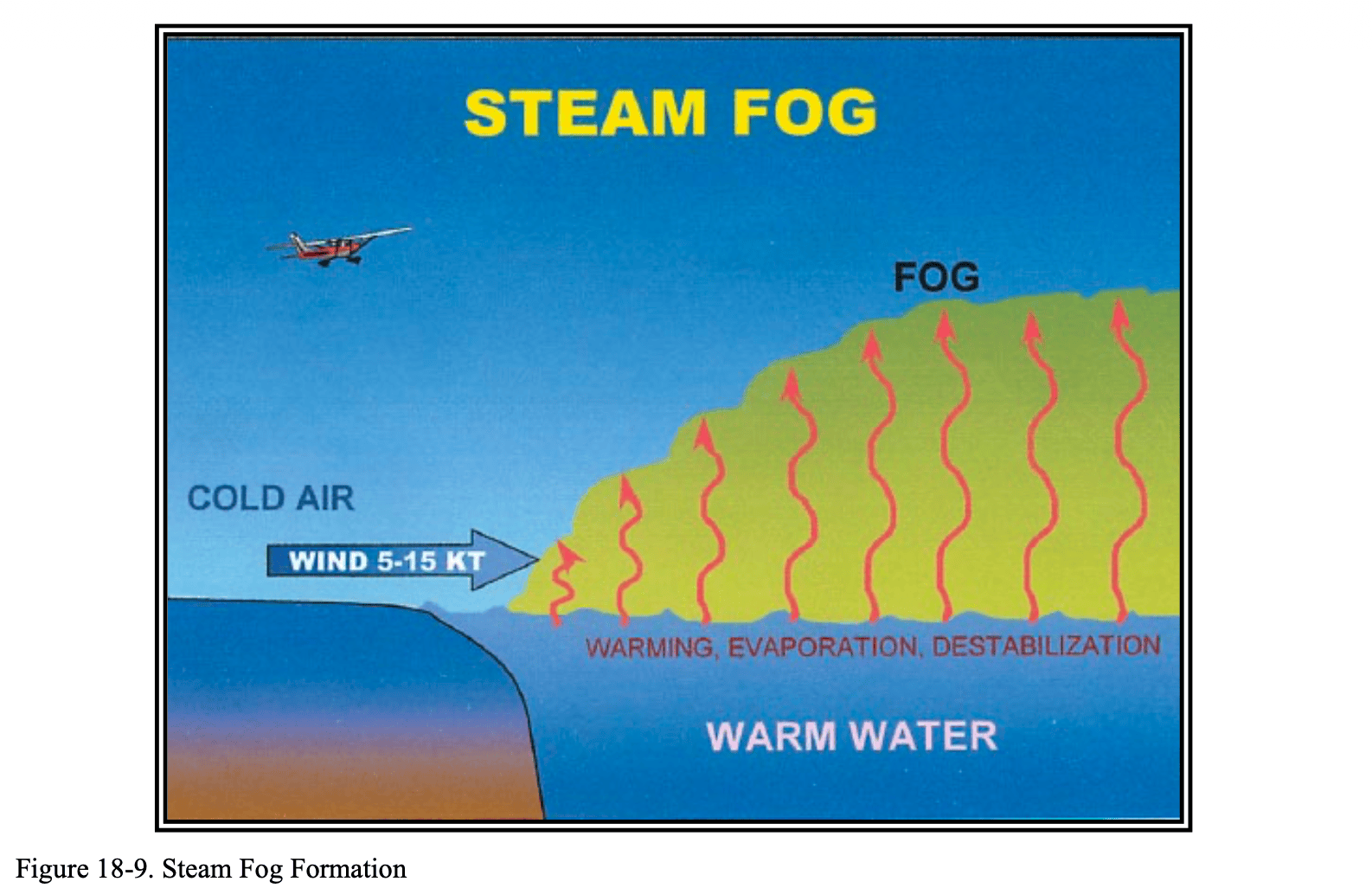
- Steam Fog: The steam fog, sometimes called “sea smoke,” and we see this over the ocean or oftentimes the Great Lakes or big lakes. This is cool, dry air moving over warmer water. Cool air does not hold as much moisture, and as it moves over this warm water, it starts to pick up water vapor and moisture, but at that cool temperature, it won’t hold very much before it condenses into fog.
Precipitation
Precipitation is any of the forms of water particles, whether liquid or solid, that fall from the atmosphere and reach the ground. Snow, rain, and drizzle are types of precipitation.
- Drizzle & Rain:
Drizzle is like a light rain. Rain is droplets of water that have coalesced to approximately two millimeters across—maybe big rain droplets or five millimeters. It is visible to the naked eye, and so enough water vapor in the air has coalesced into that little raindrop, and that’s rain. - Virga:
Now if those raindrops are falling out of the cloud and into air below it where that air below it can absorb that moisture, that rain evaporates before it hits the ground. - Hail:
Hail is formed in vertically developed clouds, and little ice balls are taken vertically up through this cloud and they freeze, and they hit additional raindrops as they fall down or are moved up by these powerful vertical wind currents—this vertical wind turbulence. And as those ice balls start to circulate through this vertically developed cloud, they get bigger and bigger and bigger, and eventually become hail. - Ice Pallets:
Ice pellets are slightly different. Ice pellets start out as snow; snow falls out of the cloud into warmer air below and melts, and then it re-refreezes. And it re-refreezes into kind of a pellet, a frozen pellet shape, ice pellets. - Snow:
Snow is moisture below freezing in a crystallized form. Falls down, oftentimes makes a beautiful white scenery where it blankets the earth.
Summary Tables of Clouds
| Category | Altitude (Temperate) | Prefix | Common Types |
|---|---|---|---|
| High-level | > 23,000 ft | Cirro- | Cirrus, Cirrocumulus, Cirrostratus |
| Mid-level | 6,500 – 23,000 ft | Alto- | Altocumulus, Altostratus |
| Low-level | SFC – 6,500 ft | - | Stratus, Cumulus, Stratocumulus, Nimbostratus |
| Vertical | SFC - 23,000 ft | Cumulo- | Cumulonimbus |