Coriolis Effect & Global Circulation
Coriolis Force
The Coriolis Force, by definition, is the force created by the rotation of the Earth.
Coriolis effect and its effect on the horizontal movement of air
- Coriolis effect about air moving toward the equator
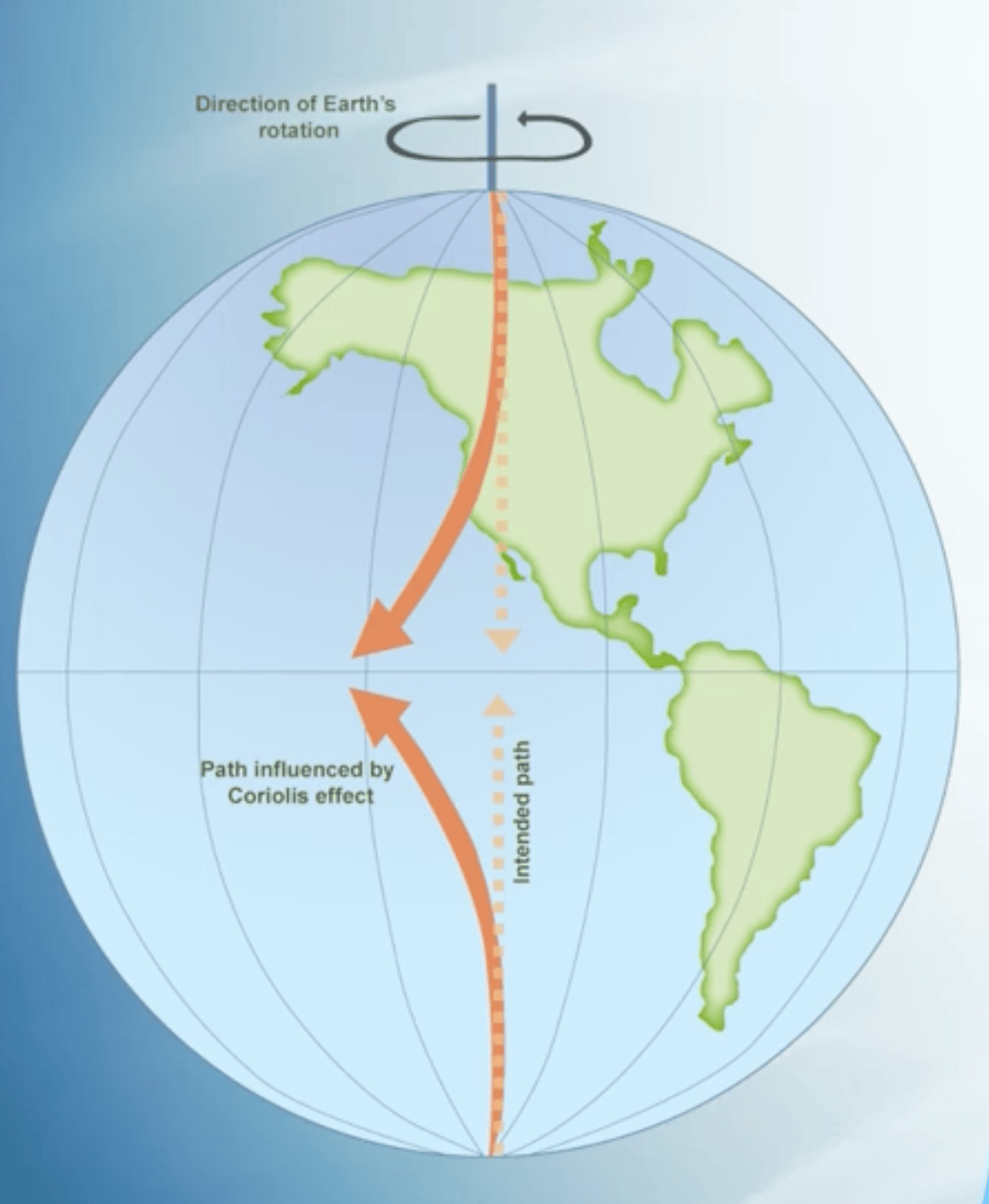
The Coriolis effect is an apparent force caused by the Earth’s rotation that deflects moving objects (such as air masses, water currents, or projectiles) to the right in the Northern Hemisphere and to the left in the Southern Hemisphere.
It is not a “true” force in the sense of a push or pull; rather, it is an inertial force that appears because we are observing movement from a rotating frame of reference (the Earth).
- Coriolis effect also affects air moving along the Equator.
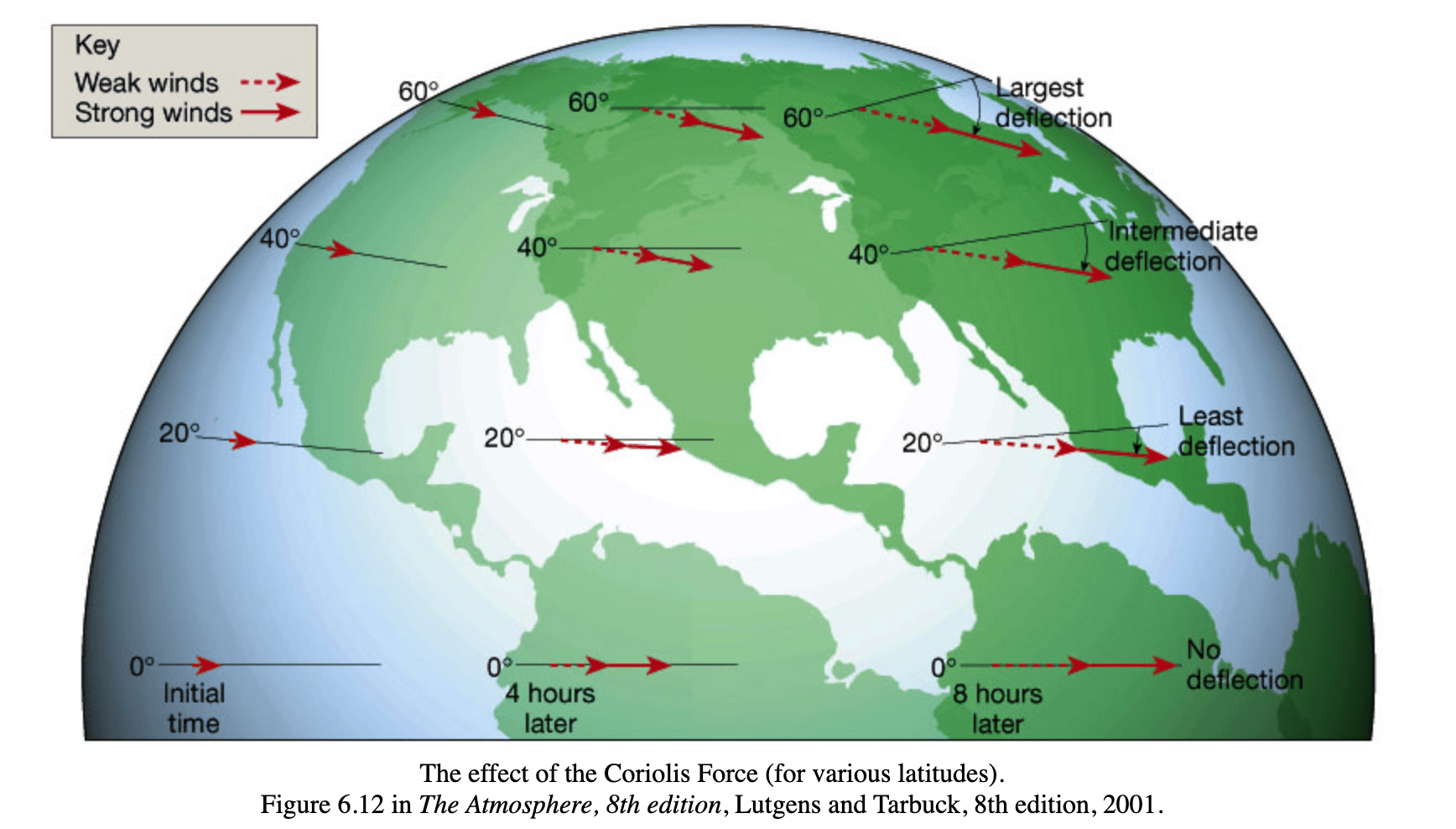
The atmosphere is pulled along by the Earth and appears to turn right as we move north because as the atmosphere is being pulled along parallel to the equator, as we move north, we are covering less and less ground. You can see an example of that here in the diagram above. Now also in this diagram you can see that that effect becomes stronger the closer we get to the poles. Why? Because there is less and less surface area to cover as we move closer and closer to the poles. That’s called the conservation of angular momentum.
Coriolis effect and its effect on the vertical movement of air
- Vertical Movement of Air - Convection Now in order to understand that let’s begin with this diagram where we look at how the sun heats the Earth’s surface.
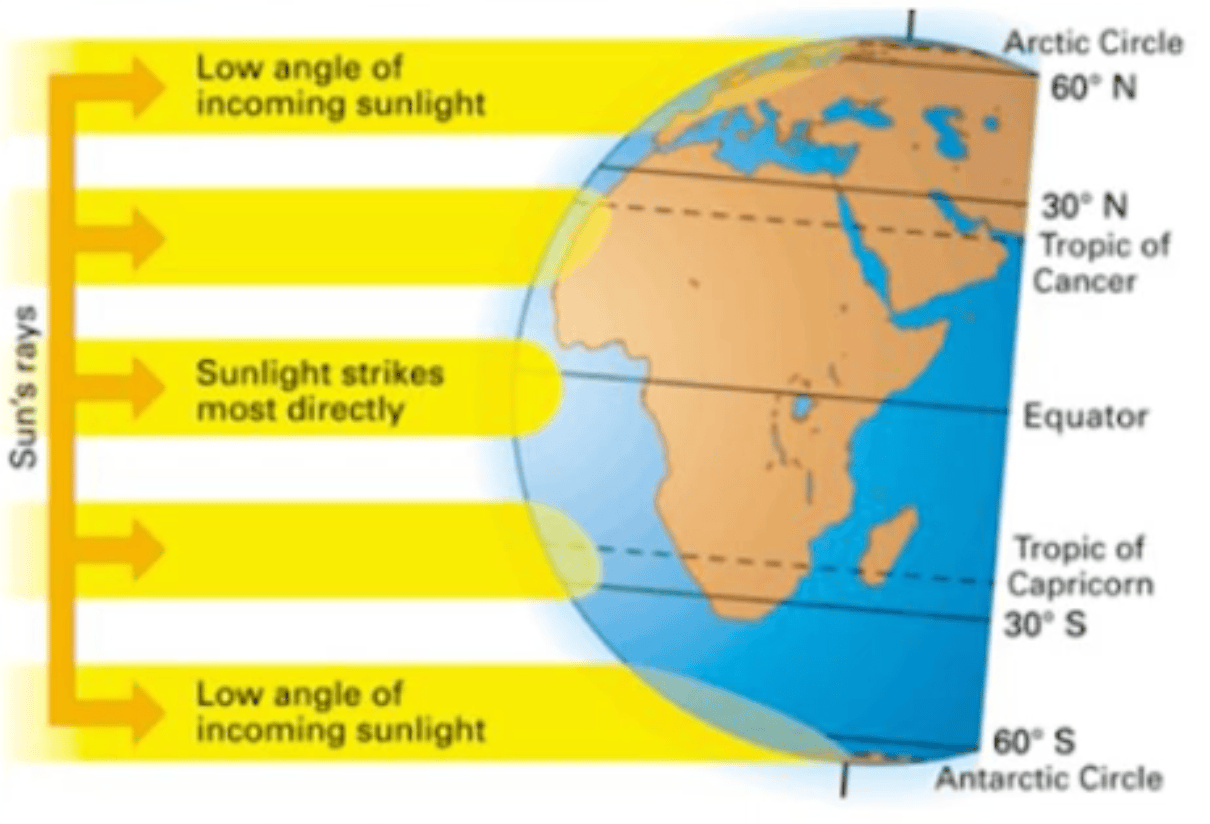
- The sun’s rays are hitting the Earth’s surface at a different angle. The closer to the Equator the sun is more direct and as we move towards the pole that same amount of incoming sunlight is spread over a larger and larger surface area, so of course the planet gets cooler near the poles.
- The sun will heat the Earth differently depending upon the surface. Land masses will heat and cool faster; water, such as the oceans, will heat and cool slower. This will affect the vertical movement of air.
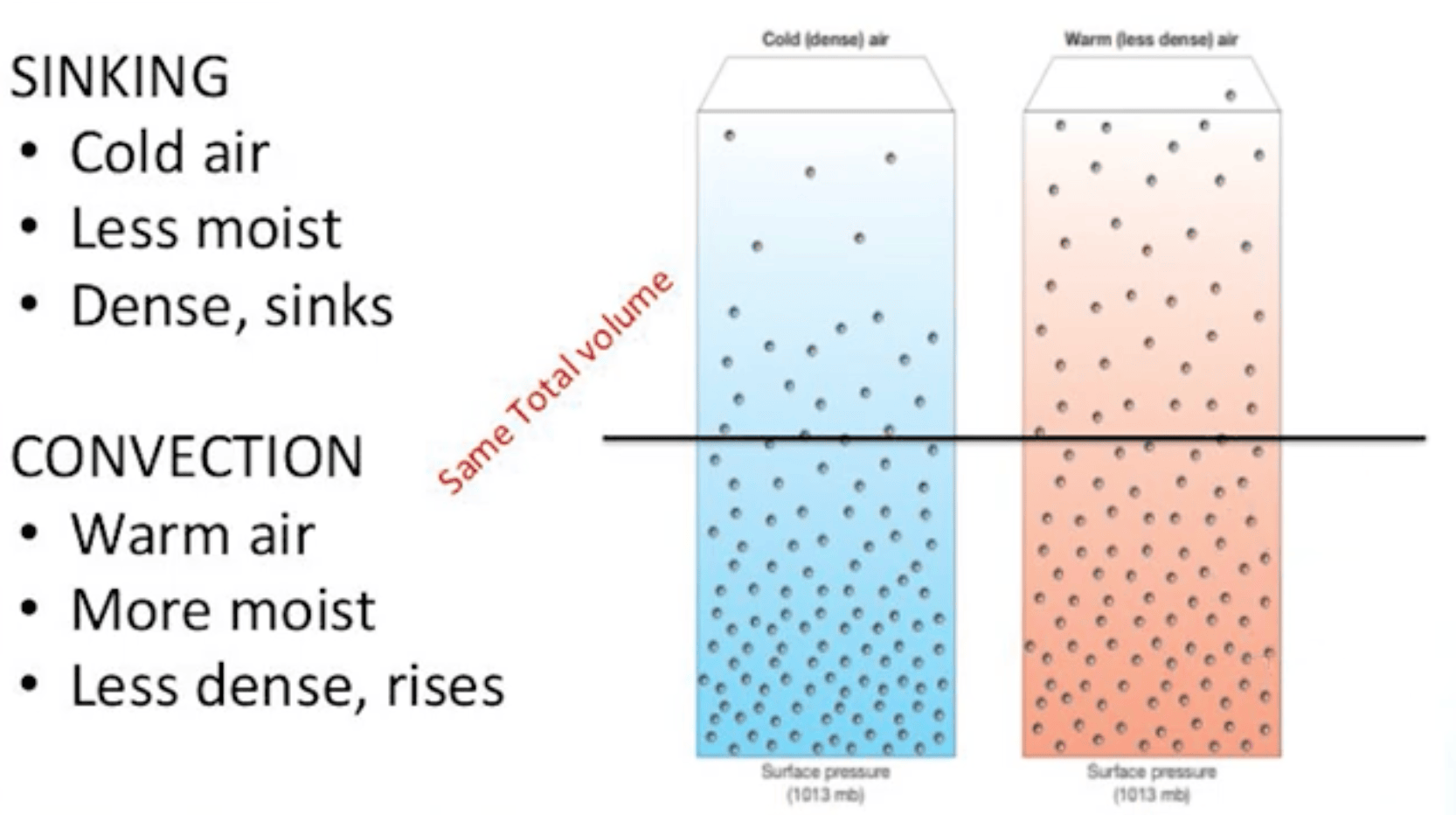
Now we know that sinking air is cooler, it’s less moist and more dense; warm air is more moist and tends to rise. Well do you ever wonder exactly why that happens? I want you to take a look at this diagram and see in both cases (the blue column and the orange or red colored column) we have theoretically the same volume of air. But notice because the blue column is cooler, more of that air is settling to the bottom. Notice we’ve outlined here the halfway point in these two vertical columns so if you can imagine they have the same volume, you see how in the red column it’s more spread out and in the blue column it’s more condensed near the bottom. This is what we mean by cold air sinking and warm air rising. That warm air rising we know as convection.
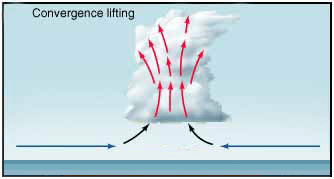
- Vertical Movement of Air - Convergence The word convergence means, “to come together.” Typically, this happens when air streams flow on convergent paths, either obliquely or directly toward each other. This is fairly common on islands or peninsulas, which heat during the day and draw onshore air from all directions in sea breezes. The air converges, bumps into each other, and rises.
Pressure Gradient Force (PGF)
One more key thing to understand before we discuss atmospheric circulation is pressure gradient force or PGF.
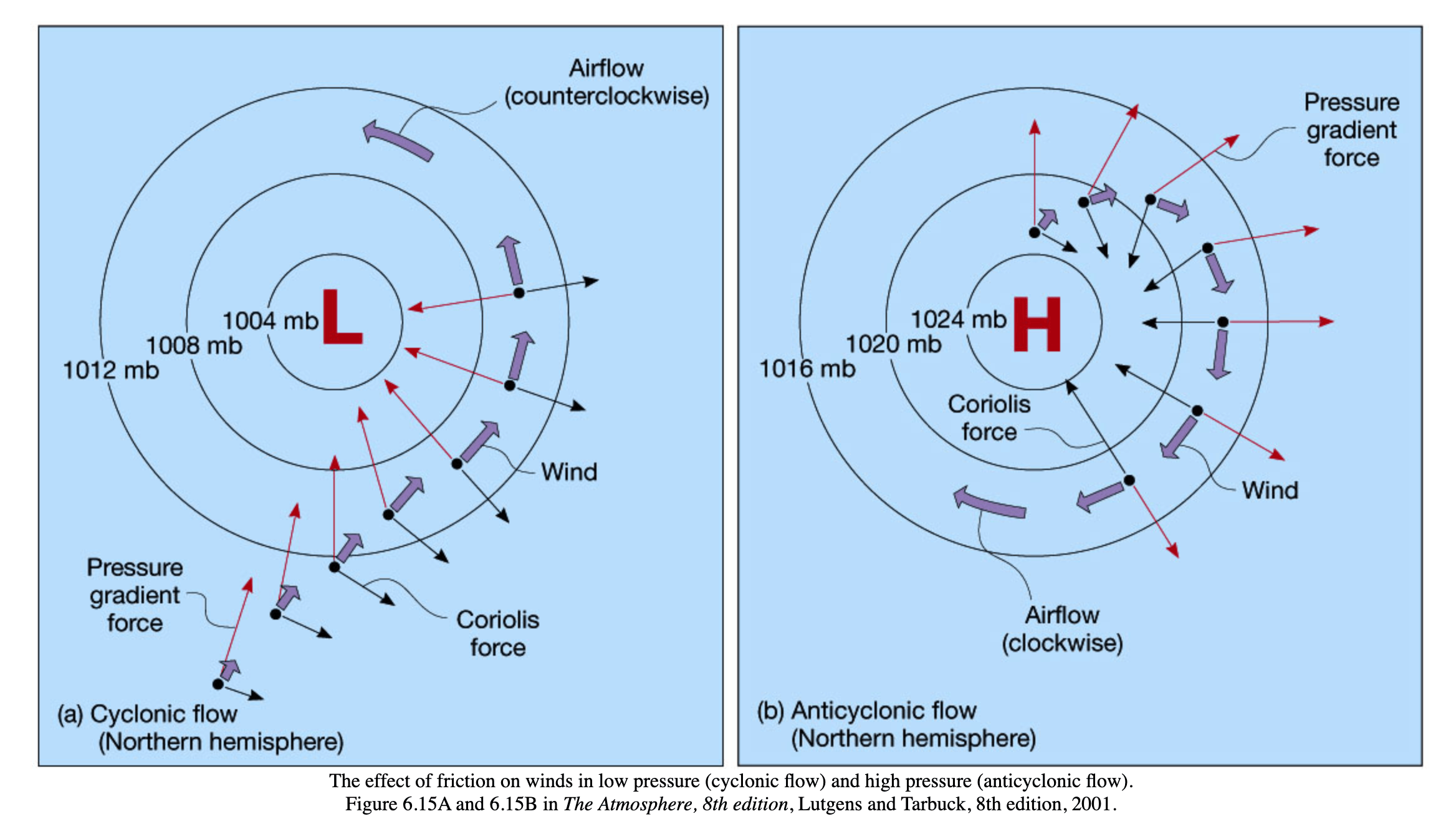
Now what does that mean? Remember the atmosphere will seek a balance, so it will flow from a high pressure and into a low pressure. If you take a look at our diagram here you can see that the red line is the pressure gradient force and it turns right in both cases. In the high pressure it’s flowing away toward low pressure and you can see the red line which is our pressure gradient force being turned to the right by Coriolis Force.
In the low pressure it’s the same thing: the red line is the pressure gradient force flowing into or toward the low and again it is being turned to the right by Coriolis Force.
Friction Force
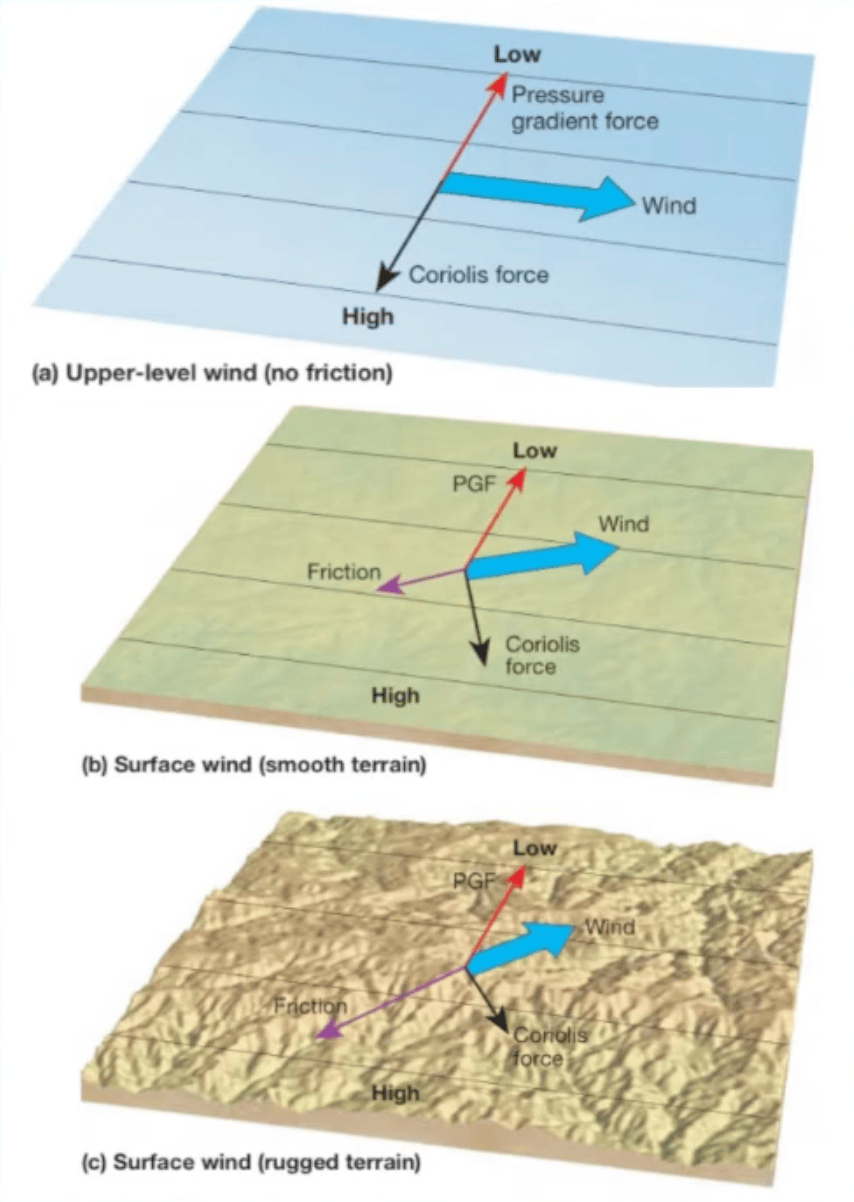
Pressure gradient and Coriolis forces work in combination to create wind. Pressure gradient force causes air to move from high pressure areas to low pressure areas. As the air begins to move, Coriolis force deflects it to the right in the northern hemisphere. This results in a clockwise flow around a high pressure area. The deflection continues until pressure gradient force and Coriolis force are in balance, and the wind flows roughly parallel to the isobars. As the air flows into a low pressure area, it moves counterclockwise around the low. This generally holds true for upper air winds.
However, within about 2,000 feet of the ground, friction caused by the earth’s surface slows the moving air. Friction causes wind to shift directions when near the earth’s surface.
This frictional force reduces the Coriolis force.
Since the pressure gradient force is now greater than Coriolis force, the wind is diverted from its path along the isobars toward the lower pressure.
Global Circulation
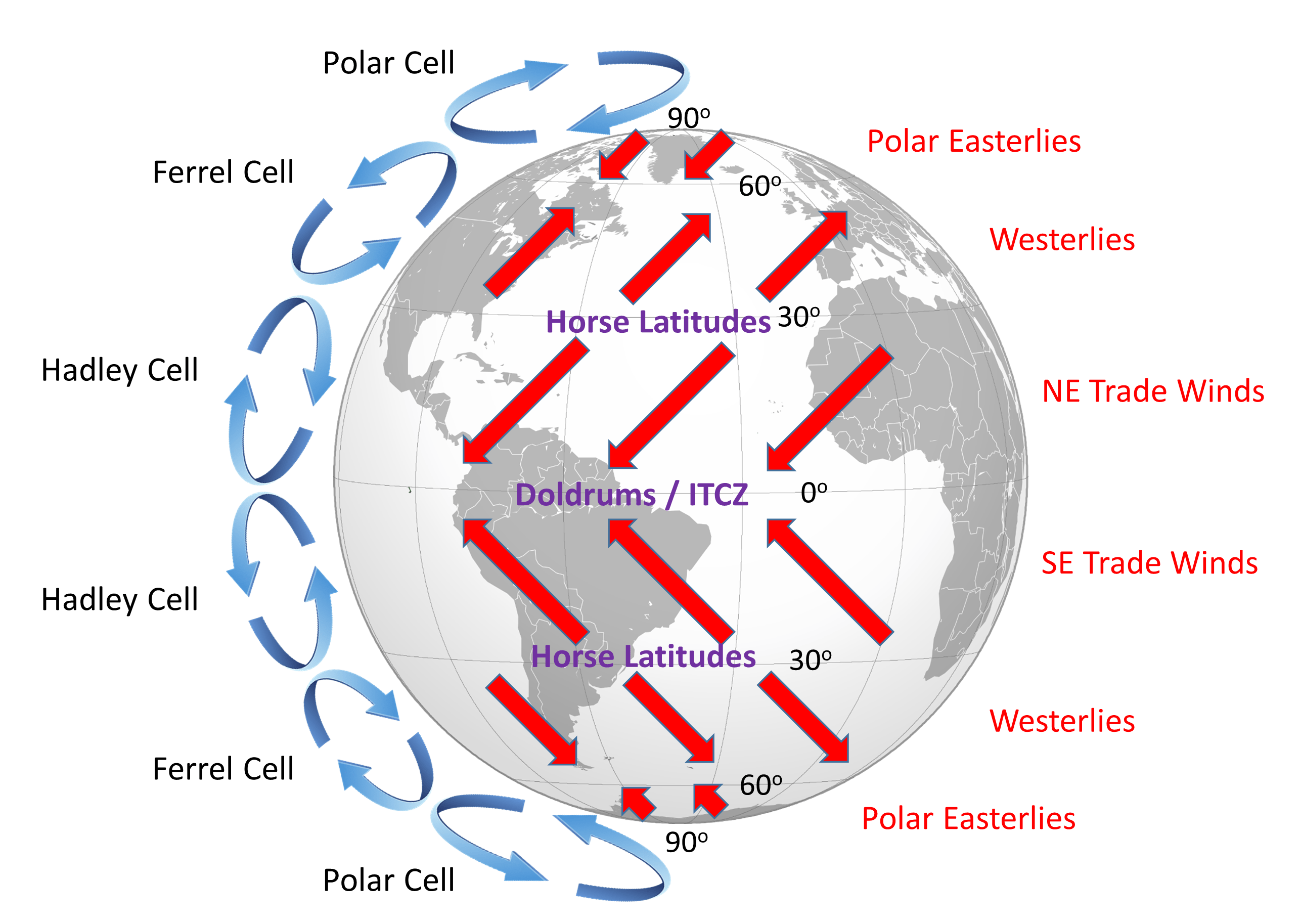
So if we can put all three of these keys together—horizontal movement of air, vertical movement of air, and pressure gradient—we could have a better understanding of global circulation.
In global circulation there are three major cells: the Hadley cell, the Ferrel Cell, and the Polar cell.
Hadley Cell (0°–30°)
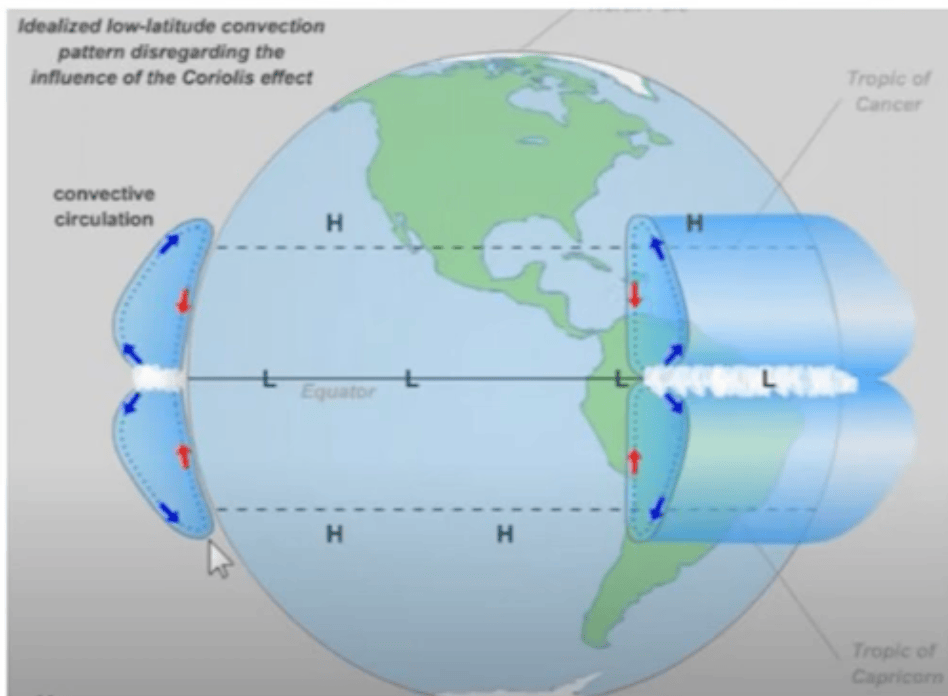
In the diagram above we are first disregarding the Coriolis Force. We can see that the Earth is much warmer near the equator and you can see this air starts to rise and at some point it will start to diverge both North and South. It will stop rising at the tropopause (the bottom of the stratosphere). The air will then proceed to the north and south, and as it travels toward the poles, it starts to cool and will fall towards the surface of the Earth at approximately 30 degrees of latitude.
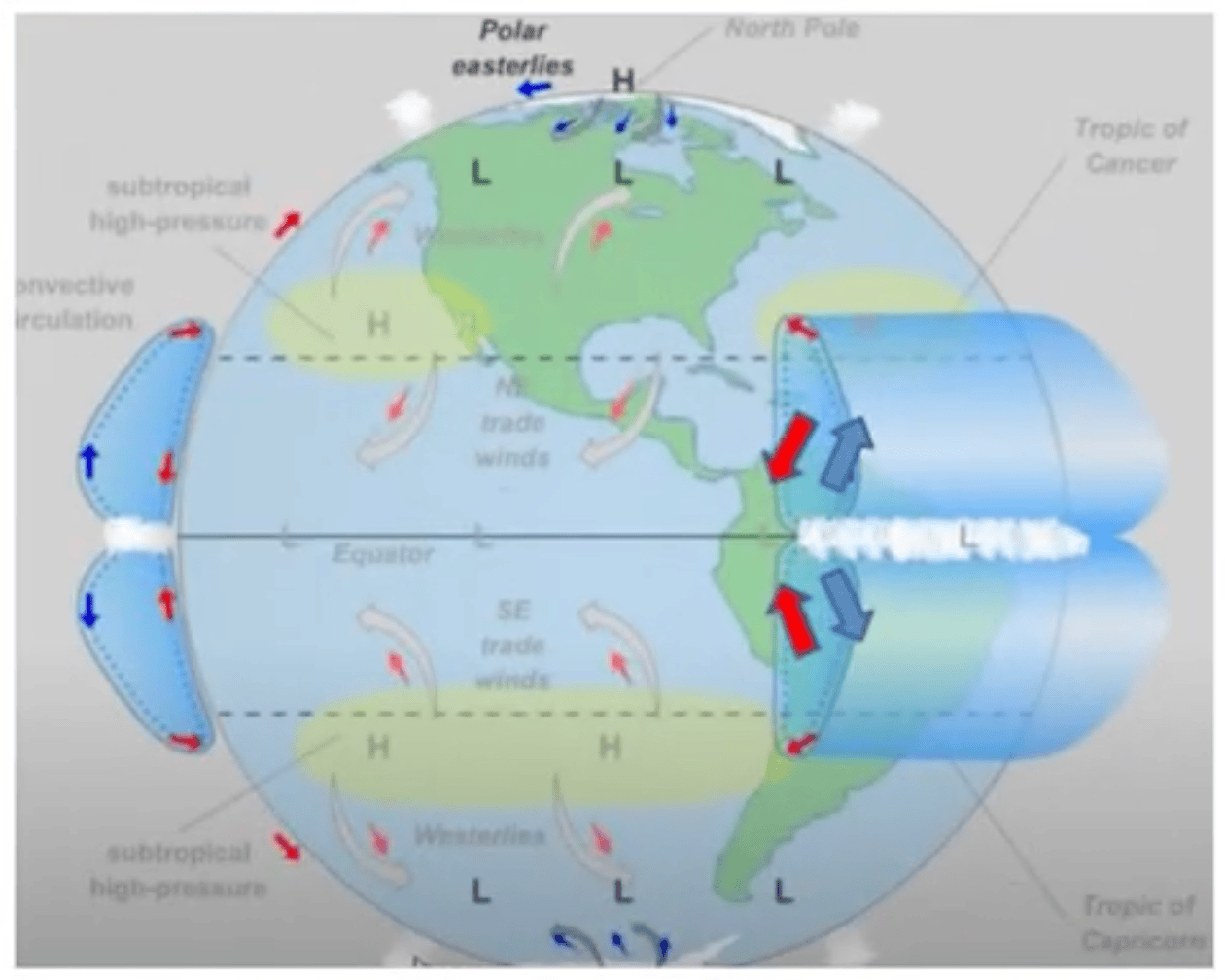
Now, when we add Coriolis Force, we can see in this diagram Coriolis force is turning the surface flow to the right. We also see Coriolis turning the aloft flow to the right.
This circulation creates what is called the Hadley cell. At the Equator the air warms as it rises, starts to cool losing moisture, and is deflected to the right heading north aloft. It creates high pressure when it starts to sink near 30 degrees of latitude. At the surface, Coriolis Force directs it to the right; these are called the trade winds.
Polar Cell
The polar cold air sinks. As this cold air sinks and starts to flow south, it is also warmed by compression. As it flows south it starts to warm and at approximately 60 degrees it is ready to rise back up creating predominant low pressure along 60 degrees of latitude.
As it flows south from the pole it is turned right in the Northern Hemisphere and the wind appears to come from the East; these are called “Polar Easterlies”.
Ferrel Cell
While air is sinking at about 30 degrees of latitude and it’s rising at about 60 degrees of latitude, this causes low pressure at 60 degrees and higher pressure at 30 degrees. Air will flow from high towards low, or from 30 degrees toward 60 degrees, to fill in that low pressure. This results in what we call the Ferrel Cell.
The Ferrel Cell is driven by the other two cells. Air is drawn north from the high pressure at 30 degrees toward the low pressure at 60 degrees where it rises and returns south aloft.
At 60 degrees these two airflows (the Polar cell coming south and the Ferrel Cell coming north) are converging. These two airflows collide, converge, and start to rise. The warmer air coming from the south rides up over the top of the cold air coming from the pole; this creates the polar front.
Summaries
Summary of the Three-Cell Model
| Cell | Latitude | Characteristics |
|---|---|---|
| Hadley Cell | 0° – 30° | Warm air rises at Equator, sinks at 30°. Creates Trade Winds. |
| Ferrel Cell | 30° – 60° | Driven by the other two cells. Creates the Prevailing Westerlies. |
| Polar Cell | 60° – 90° | Cold air sinks at Poles, rises at 60°. Creates Polar Easterlies. |
Circulation Diagram of Northern Hemisphere
LATITUDE       VERTICAL MOTION      ACTUAL SURFACE FLOW (Coriolis Right)
---------------------------------------------------------------------------
90°N (Pole)     [ SINKING ]          ↙   ↙   ↙   ↙   ↙   ↙
                (High Press)        (Winds coming from the NE)

60°N            [ RISING ]           ↗   ↗   ↗   ↗   ↗   ↗
                (Low Press)         (Winds coming from the SW)

30°N            [ SINKING ]          ↙   ↙   ↙   ↙   ↙   ↙
                (High Press)        (Winds coming from the NE)

0° (Equator)    [ RISING ]           ~ ~ ~ ~ ~ ~ ~ ~ ~ ~ ~ ~
                (Low Press)          (The Doldrums / ITCZ)
---------------------------------------------------------------------------