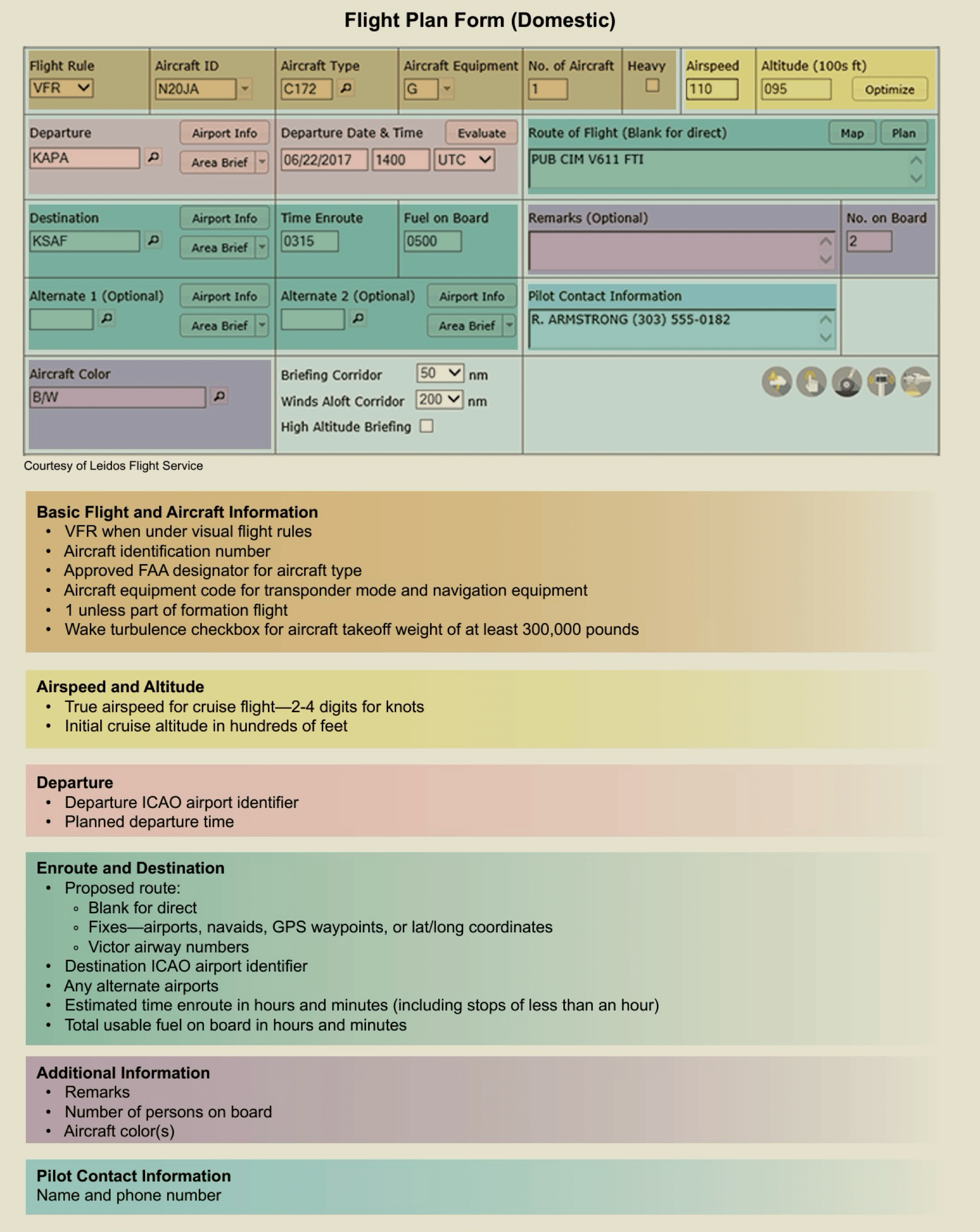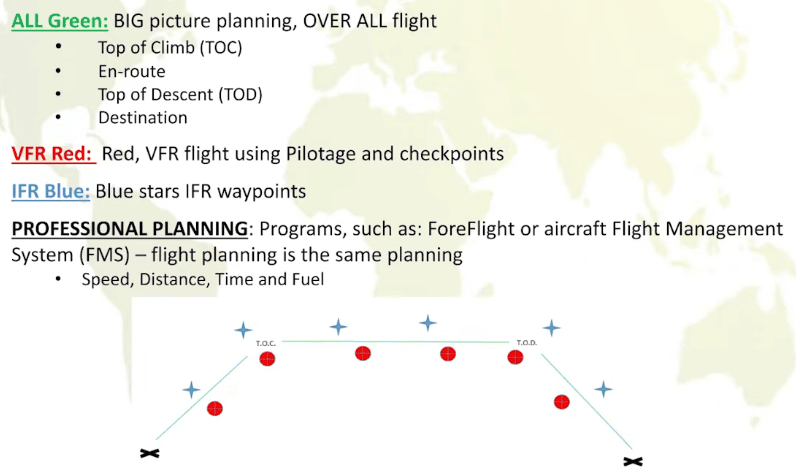
The idea of the big picture of a VFR flight plan, which contains mainly 4 parts: Preflight, Departure, En Route, and Arrival.
The big picture really kind of follows chapter 5 in the AIM (Aeronautical Information Manual). Read more at https://www.faa.gov/air_traffic/publications/.
Planning Considerations
Fuel:
When we’re talking about fuel, the FAR that we need to refer to for VFR is FAR 91.151.
No person may begin a flight in an airplane under VFR conditions unless (considering wind and forecast weather conditions) there is enough fuel to fly to the first point of intended landing and, assuming normal cruising speed—- During the day, to fly after that for at least 30 minutes; or
- At night, to fly after that for at least 45 minutes.
Weather Briefing: Pilots are encouraged to use automated resources and review Advisory Circular AC 91−92, Pilot’s Guide to a Preflight Briefing. Standard briefings include:
- Adverse Conditions
- Synopsis
- Current Conditions
- Forecast Conditions
- Winds Aloft
- Notices to Airmen (NOTAM)
Weight and Balance: At this point, you are ready to complete your weight and balance because you have a clear idea of your fuel load, which figures critically into the calculation.
VFR Cruising Altitude: Pilots select a VFR cruising altitude based on winds aloft and the most conducive conditions. According to FAR 91.159, when operating above 3,000 ft AGL:
- 0° – 179° magnetic course: ODD thousands + 500’ (e.g., 3,500, 5,500).
- 180° – 359° magnetic course: EVEN thousands + 500’ (e.g., 4,500, 6,500).
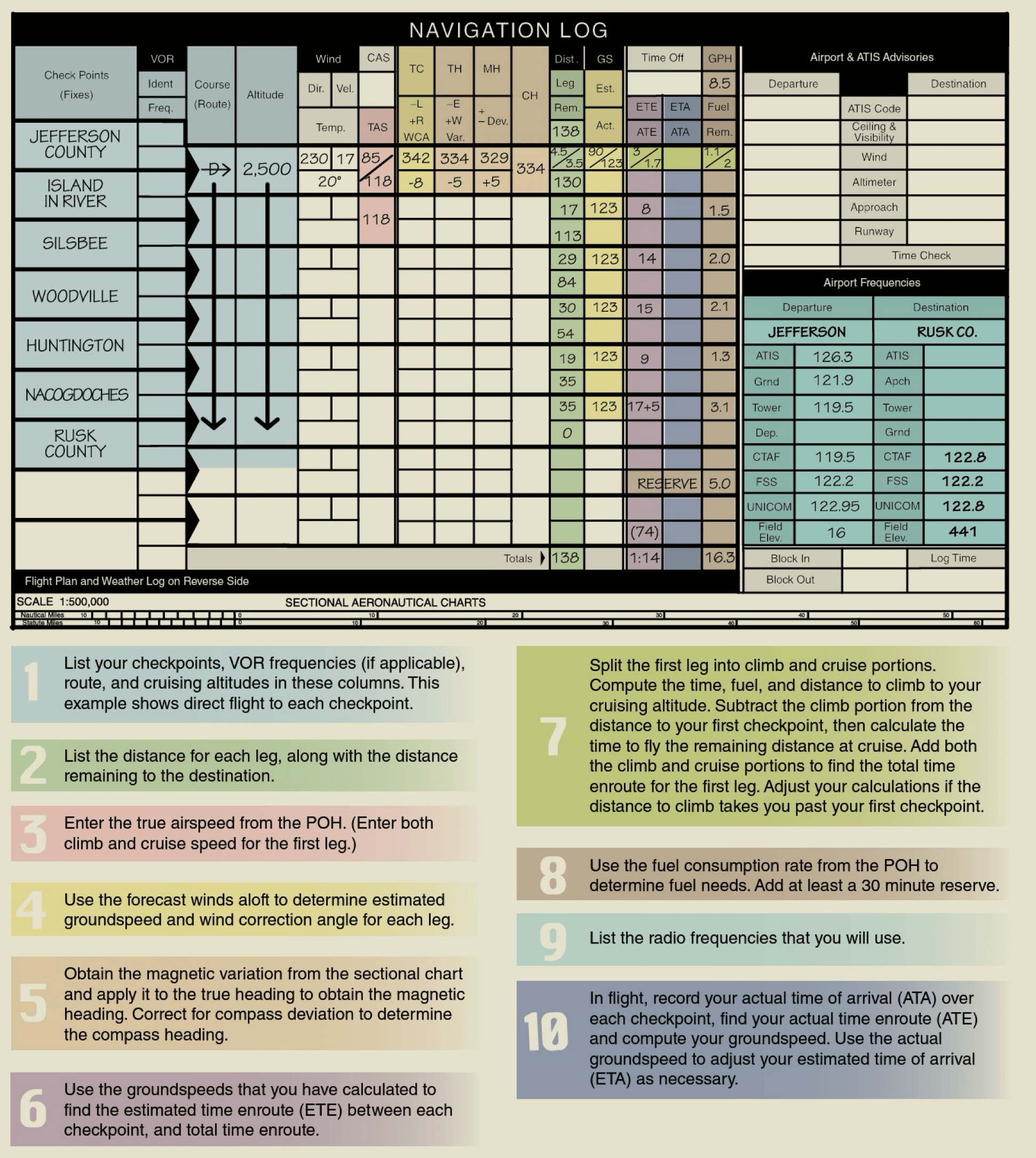
Fill in Nav Logs: Basics of the weather brief are filled on the back of the nav log. Calculate performance numbers (e.g., TAS, RPM, MCP) and enter them into the log.
Charting the Course: Draw a line across the sectional chart indicating the course using a plotter.
Heading Corrections: True Course (TC) is corrected for variation to get Magnetic Course (MC). MC is corrected for wind to get Magnetic Heading (MH). MH is corrected for compass deviation to find the final Compass Heading (CH).
Read more at Navigation (Flight Planning)Checkpoint Selection: Select VFR checkpoints along the route, suggested to be approximately 20 to 30 miles apart.
Navigation Logs
Flight Plan