Airspeed Color Markings
Tips: So → Fe → S1 → No → Ne
(“So fancy, no need!”)
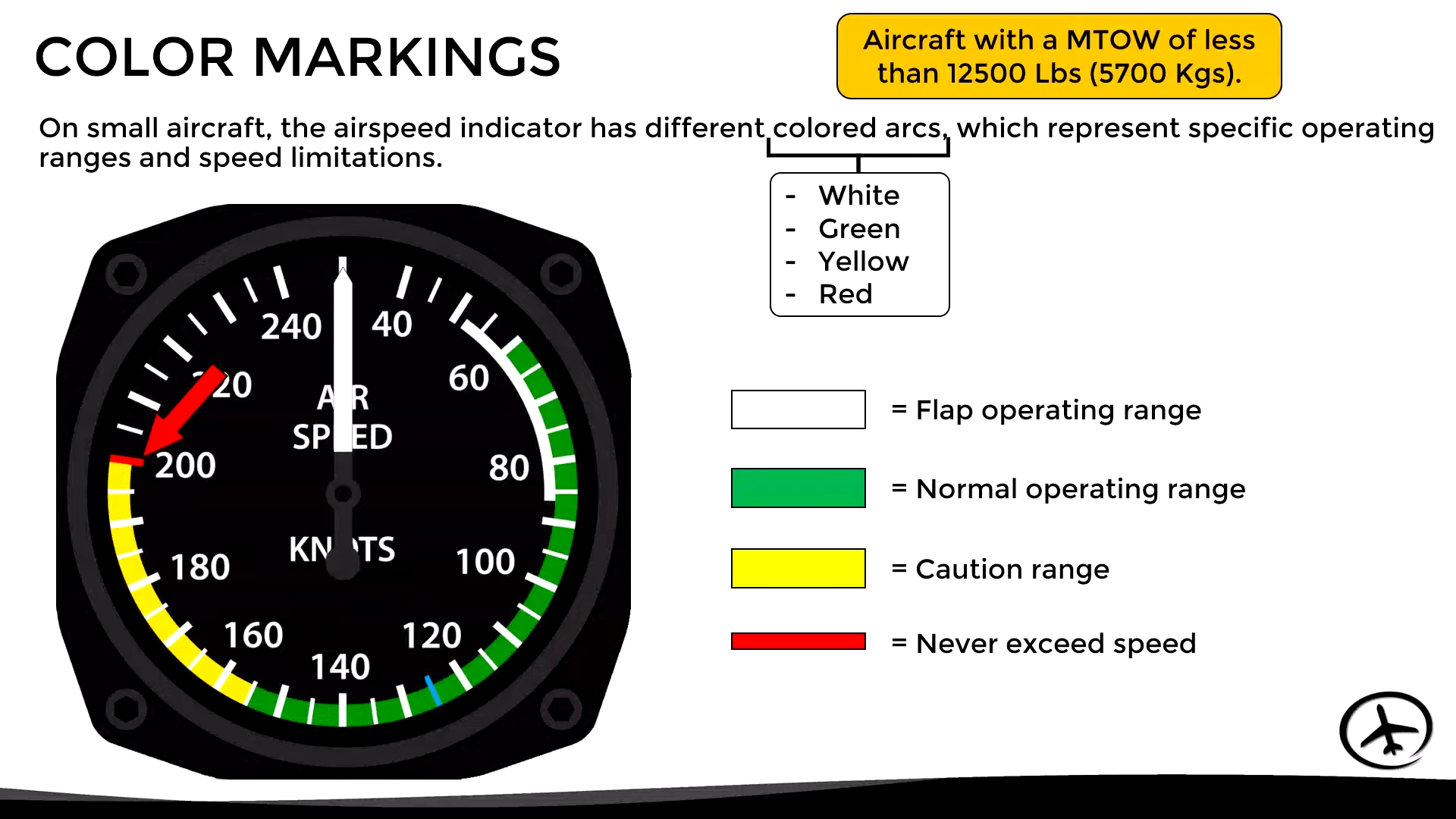
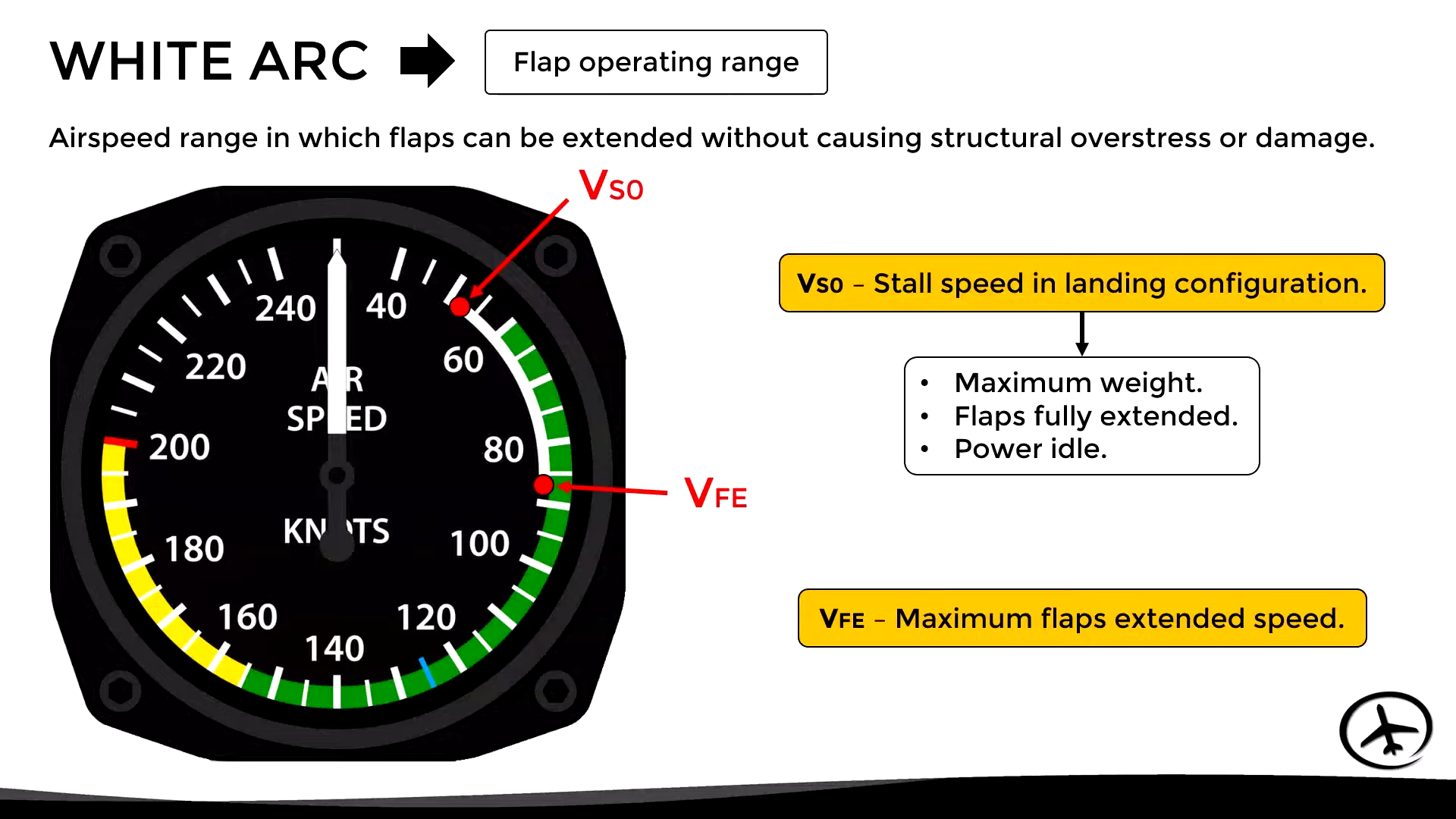
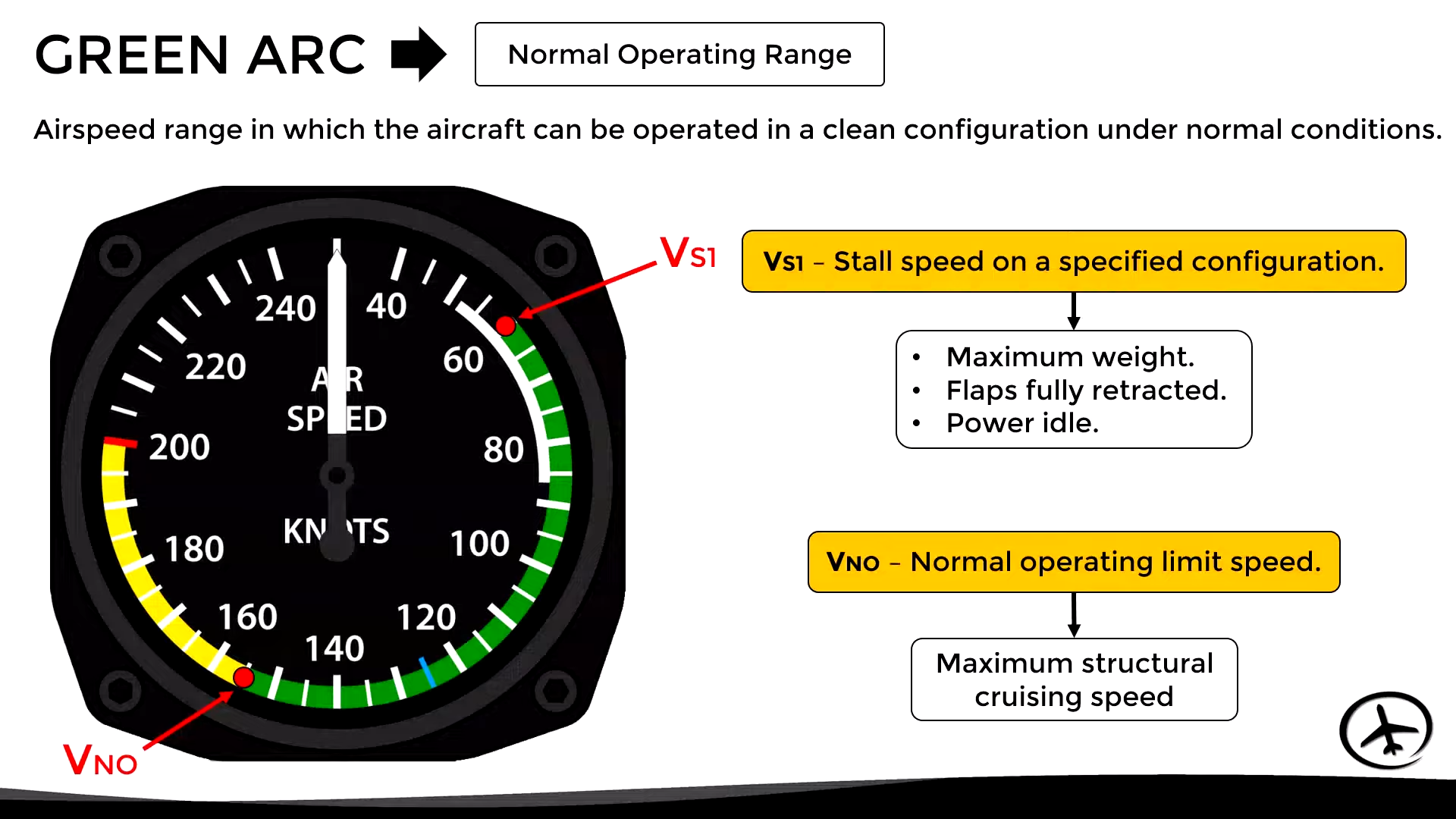
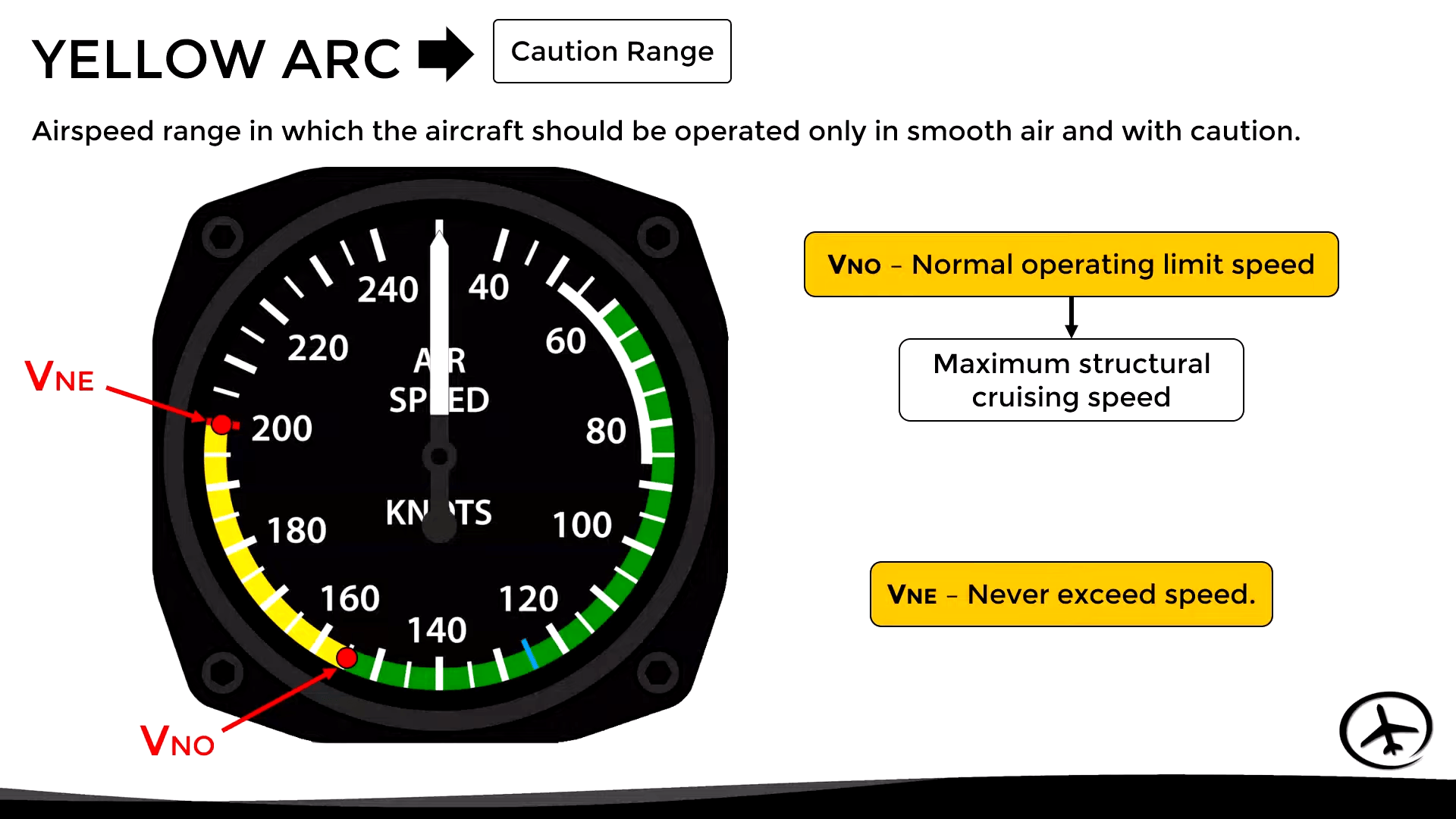
| Color Arc | Speed Range Name | Description |
|---|---|---|
| White Arc | Flap Operating Range | Starts at $V_{SO}$ (Stall speed in landing configuration) and ends at $V_{FE}$ (Maximum flap extended speed). |
| Green Arc | Normal Operating Range | Starts at $V_{S1}$ (Stall speed in a clean configuration) and ends at $V_{NO}$ (Maximum structural cruising speed). |
| Yellow Arc | Caution Range | Range between $V_{NO}$ and $V_{NE}$. Operate within this range only in smooth air and with caution. |
| Red Line | Never Exceed Speed | $V_{NE}$; exceeding this speed may cause structural failure. |
Other Airspeed Limitations
- Design maneuvering speed : The maximum speed at which the structural design’s limit load can be imposed (either by gusts or full deflection of the control surfaces) without causing structural damage. It is important to consider weight when referencing this speed. For example, may be 100 knots when an airplane is heavily loaded, but only 90 knots when the load is light.
- Landing gear operating speed : The maximum speed for extending or retracting the landing gear if flying an aircraft with retractable landing gear.
- Landing gear extended speed : The maximum speed at which an aircraft can be safely flown with the landing gear extended.
- Minimum control speed : The minimum flight speed at which a light, twin-engine aircraft can be satisfactorily controlled when an engine suddenly becomes inoperative and the remaining engine is at takeoff power.
Related Topics
& ?
- Best angle-of-climb speed : The airspeed at which an aircraft gains the greatest amount of altitude in a given distance. It is used during a short-field takeoff to clear an obstacle.
- Best rate-of-climb speed : The airspeed that provides the most altitude gain in a given period of time.
- Single-engine best rate-of-climb : The best rate-of-climb or minimum rate-of-sink in a light twin-engine aircraft with one engine inoperative. It is marked on the ASI with a blue line. is commonly referred to as “Blue Line.”
Last updated on